Showing posts with label space. Show all posts

Sunday, August 1, 2021

Project Hail Mary by Andy Weir--A NO SPOILER REVIEW


It goes without saying the movie version of The Martian was a brilliant piece of hard science fiction. I was literally in awe of the actors performance, the real science involved in the story, along with the basic concept of a lone individual marooned on a planet. Because I enjoyed the movie so much I naturally bought the Andy Weir novel which I found surpassed the movie. It was true “hard science fiction” in the sense that there was no magic gadgets that defy known physics used to save the day. Everything in the movie and novel is technologically possible.

Even growing potatoes in martian soil, the only show stopper being the weird type of salt in the martian regolith that Mr. Weir didn't know about when he was writing the book. Called perchlorates, this type of salt would make growing plants in Martian soil difficult, to say the least. But this doesn't derail the use of martian soil as material for growing Earth plants. Such salts could easily be washed out of the soil as it's put into greenhouses.

So when I learned of the basic plot of his latest novel, Project Hail Mary, I was like a kid waiting for Santa on Christmas Eve. I ordered the book off Amazon and had a fit when the United States Postal Service failed to deliver it in the required two days. But it did arrive and I have to go ahead and say Project Hail Mary is one of the best science fiction books I have read in my life. Now, understand it's the best science fiction books I've read, but it's not HARD science fiction.

The book opens in more or less in the present day with a probe being sent to Venus and discovering an alien single-cell lifeform reproducing uncontrollably around the sun. Yes, its definitely growing around the sun and causing significant dimming that will plunge the entire Earth into an ice age in thirty years.

This of course sends all rational countries into terror because while the sun will not be extinguished the percentage of dimming will cause massive crop failures resulting in billions dying around the world. Needless to say an ecological collapse will also result in a mass extinction event as well for most plants and animals. So it's the end of the world and no amount of climate denial and anti-science rhetoric will stop the advanced rational nations from a crazy project to try and save it.

Enter the main character Ryland Grace PhD, a humble junior-high school biology teacher who was forced to leave advanced molecular biology research because he wrote a controversial paper proposing that life could exist without using water.

The almighty overlord of project Hail Mary, Eva Stratt picks Grace to study the samples of the lifeform being brought back to Earth. Mainly because everyone was assuming that since the organism was growing on the sun that it couldn't possibly contain water. But also because of the fact that Stratt wanted a competent, but highly replaceable, scientist to look at the organism first. In other words if the organism killed Grace while he was poking it with a stick there was essentially no loss to humanity.

Well Ryland Grace makes significant breakthroughs in classifying the organism he names “Astrophage.” It uses the carbon dioxide from the atmosphere of Venus to reproduce then emits huge quantities of light energy to get back to the sun to hang out. Astrophage's ability to emit light as a form of propulsion is discovered by other scientists and they begin figuring out a way to build a sub-light starship using it as fuel.

Why build a starship when Earth is about to become a global icebox? Because every astronomer in the world is looking for the origin of Astrophage and they discover all the local stars in our stellar neighborhood are dimming the same way. The conclusion, Astrophage has infected them all except one, Tau Ceti, a star a little under twelve lightyears away.

Project Hail Mary is an attempt to build a Astrophage-powered starship to reach Tau Ceti and hopefully find out why the single-cell assholes aren't causing it to dim. Dr. Ryland Grace end up on the three person crew of the Hail Mary, who are put into a medically-induced coma for the four-year journey to Ta Ceti. Four year journey, when you said Tau Ceti is twelve lightyears away????

Relativity my friends, old Albert Einstein isn't a character in the book but his ideas about traveling close to the speed of light means our intrepid crew will only experience four years of travel time. Why put them in a medically-induced coma? Because the Hail Mary isn't the spacious Starship Enterprise, the three-person crew would go insane living in such a small container. Plus it saves on the use of food and life support during the voyage. Of course while the crew will only “experience” four years, time dilation means those left on Earth will experience more and with only a total of thirty years left before Earth goes full dead block of ice the possibility of success is remote.

Oh yeah, the crew on the Hail Mary are all on a suicide mission. To save Earth they have to reach Tau Ceti discover why that star isn't dimming. If they find a solution they will launch four small probes back to Earth that will carry the information on how to solve the problem. After that all three have ways to painlessly end their own lives.

It simply wasn't practical to build a starship with enough fuel for a return voyage to Earth.

Needless to say like any battle plan going to shit when opposing forces make actual contact, lots of crazy, scary, unplanned events happen to those aboard the Hail Mary. Small spoiler here but the star 40 Eridani, another in the local neighborhood that is also dimming plays a part in the novel.

Project Hail Mary isn't hard science fiction, but it an excellent novel in its own right. “Astrophage” naturally doesn't exist and along with a few other created elements prevents this novel from being hard science fiction.

Another curious thing about this is book is the seemingly lack of direct American involvement with the Hail Mary Project. That why I said all 'advanced rational nations' at the start of my review. Of course Ryland Grace is American but during the construction of the Hail Mary every major spacefaring nation including the multinational European Space Agency (ESA) seem to have far more involvement than NASA. One example, after the Hail Mary is built and in orbit around the Earth, it is astronauts of the ESA that crew the ship during during testing. The reason why Andy Weir wrote the story that way is unclear.

Personally, the first thought that came to my mind is that I could easily see the antiscience dumbasses here in the United States denying that any problem with Astrophage and the sun existed. I could easily see dozens of right-wing religious extremists and libertarians saying Astrophage was all an evil globalist plot to undermine the United States. Those same individuals say the same thing about climate change, pollution, and numerous other real issues the world and our nation faces.

During the book I began to feel for the character of Ryland Grace and his situation as he attempts to save Earth. His situation gets extremely dire several times with only luck and pure intelligence saving the day. Grace is a true hero but he's no Captain Kirk nor Picard by any means. He has a serious flaws and they are exposed during the course of the novel. But I also felt his excitement as he made numerous discoveries trying to get to the ultimate goal. The fictional Ryland Grace is a twenty-first century man who truly got to voyage, “where no one has gone before.”

I highly recommend Project Hail Mary.

Sunday, December 20, 2020

News from Proxima Centauri-- Or the Galactic HOA is Watching


 It's a terrible thing to write, but few things really excite me these days. I don't worry too much about feeling that way since life, experience, and circumstance has a way of blunting the child-like enthusiasm that made everyday an adventure when we were younger. Still, it's nice to occasionally have something come out of left field and rekindle a hint of that former awe and wonder.

Proxima Centauri is a M-class red dwarf star about 4.2 lightyears away from our planet and it looks like in 2019 we received a radio signal from some source in that star system. While most likely this curious signal is just some misinterpreted radio broadcast from a purely earthly source, it has passed many of the initial checks and still cannot be explained. So yes, there is a remote chance that this radio signal originated from an advanced alien intelligence.

What really is freaking out the astronomers is that this signal is being received on the 982 megahertz frequency, a region of the radio spectrum not typically used for satellites orbiting the Earth or space probes heading out into deep space. Adding to the mystery, the frequency of this signal shifted during the broadcast which was consistent with the movement of a body orbiting that star. However there was no detected modulation of the signal, something that would allow extra information to be encoded. In essence the signal was just a long distance dial tone, empty of any significance.

There are a couple of more little tidbits to this development that make it even more intriguing. First that while Proxima Centauri is so dim and small it can't be seen with the naked eye, it's the closest star to our solar system. Secondly, we know Proxima Centauri has at least two planets orbiting it. One is an Earth-like world, called Proxima b, orbiting in its Goldilocks Zone, a region of space where liquid water could exist on the planet's surface. Understand, for Proxima b to be warm enough to have liquid water on the surface its yearly orbit of its star is just eleven hours.

Proxima b's closeness to its parent star is definitely a double-edged sword. While it gets enough warmth and light to possibly have Earth-like conditions, like liquid water on the surface, it is then subject to Proxima's massive solar flares. Most tiny and cool stars like Proxima, paradoxically produce massive flares that scientists believe would strip away any planetary atmosphere in a matter of a few decades. Some planetary theorists do suggest that a planet orbiting a red dwarf with a strong magnetic field might be able to deflect the worst of the solar flares, allowing it to retain its atmosphere.

Making Proxima b even less desirable real estate is that due to its closeness to the parent star, it is probably tidally locked with one side permanently facing the light and heat. While the opposite side is perpetually locked in a frozen night.

The other planet, Proxima c, is much larger than Earth and is so far out from its star that its takes 5.2 Earth years to complete one orbit. This world has the mass of seven Earths and is either a mini-Neptune gas planet or a super-Earth. While you can't rule out a very different form of life, this world and any moons orbiting probably was not the source of the signal.

Then again, the general consensus is that if this signal from Proxima Centauri is from an alien intelligence the beings or entities that sent it are not native to that star system. The chance that two neighboring stars develop technical civilizations “stretches the bounds of rationality.” In other words, the big interstellar empty we thought was the galaxy is probably quite crowded.

Followup observations of Proxima Centauri since 2019 have failed to find the signal again with numerous other radio telescopes joining in the search. The overwhelming odds on this signal is of course that it's a false alarm. There was one infamous radio telescope episode several years ago where an intriguing signal from deep space turned out to be inference from the observatory's break room microwave.

Still though, if an advanced starfaring civilization wanted to make contact with a primitive technical species, setting up shop on the closest star to them would be way to gauge their reaction to any overturn. If we humans give a good impression, these aliens drop by and say hello. If we scare the living shit out of them, they toss a dozen or so antimatter bombs our way to save the galaxy from a possible horde of ravaging monsters.

Just a suggestion, it would probably serve humanity very well if we straighten up our act and actually acted like an intelligent species. The neighbors could well be watching. 


Sources:

Scientists looking for aliens investigate radio beam 'from nearby star' 

The Guardian.com, December 18, 2020

Alien Hunters Discover Mysterious Signal from Proxima Centauri   

ScientificAmerican.com, December 18, 2020

Sunday, August 2, 2020

Maybe It's Aliens, If We're Lucky?


You know we live in interesting times when legitimate reports involving UFO's hit the mainstream media and they aren't the top stories in the evening news. But that is the case with both a New York Times report and the one Huffpost uploaded on their webpage.

On the surface both reports sound like the usual highly dubious and easily dismissible stories espoused by countless nutcases and con men for decades. The trouble though is that this time we have official statements from both the U.S. Navy and the Pentagon that yes, there have been sightings of strange aerial phenomenon displaying capabilities outside the abilities of current technologies.

More to the point, a few years back the Pentagon once stated that its covert program to study unexplained aerial phenomenon had been disbanded. Now real news outlets have discovered that this program was just renamed and moved to the Office of Naval Intelligence. Not exactly something an organization would do if there wasn't a reason to keep information hidden.

Those reason appear to be that these unknown craft have the ability to perform extreme maneuvers that defy known physics. One such unidentified vehicle was observed dropping from 60,000 feet to 50 feet in a matter of seconds. You don't need a degree in physics nor human anatomy to understand such maneuvers would destroy any known craft and turn any human pilot to chunky salsa.

Despite the possible crazed hoopla about aliens and first contact scenarios the more chilling possibility revolves around either Russia or China secretly developing technology that puts out best, most advanced planes on par with WW2 aircraft. Why Russia or China as possible boogeymen? Because they are the only countries with the money and/or technological clout to make such a breakthrough.

For the most part I despise Russia, but they do produce some seriously world class engineers and theoretical physicists. Their one drawback is money, it's one thing to produce fancy blueprints and maybe a prototype. It is another to have the money and industrial capabilities to turn such dreams into reality. China on the other hand does have the money, engineers, and the industrial might to possibly produce such revolutionary aircraft. What both countries do share is a grudge against the United States and an overwhelming desire to be the global top dog and remake the world pecking order.

Another possibility worth mentioning is that this release of information about UFO's is just a disinformation campaign by the United States Government. That our country has actually made a massive breakthrough in aviation technology and that we are just acting stupid to throw off our adversaries. Such possible advanced aircraft have to be tested and with surveillance what it is these days someone is bound to catch sight of these vehicles. At least that is my best case scenario when it comes to this situation.

Touching back on aliens, no I do not believe these UFO's are extraterrestrial in origin. The idea that an advanced alien race would travel hundreds, if not thousands of lightyears just to play aerial chicken with the primitive natives is just a bad science fiction movie idea. I've got admit though, given how supremely nightmarishly fucked up 2020 has been, we probably can't discount Little Green Men entirely.

See:

Explosive UFO Report In NYT Mentions ‘Off-World Vehicles Not Made On This Earth’

Sunday, June 14, 2020

Hoag's Object- A Special Place in the Universe


One of the cruelest jokes ever performed on humanity is its shared delusion of significance. Human cultures are filled with lies of how we occupy some special place in the cosmos symbolizing our importance. The truth being that we are part of an infinite universe that gets steadily more complicated from our discoveries and observations. The best that can be said about our species is that we are momentary sparks of awareness inhabiting a microscopic sliver of eternity.

One of the discoveries that remind me of our true place in the universe is Hoag's Object. It is a rare, nearly symmetrical ring galaxy six-hundred million lightyears away from our planet. Discovered in 1950 by astronomer, Arthur Hoag, he at first believed it to be a planetary nebula- a shroud of gas expelled from a star in the last stage of its life. The truth being that it's a galaxy with a diameter of 120,000 lightyears and consisting of 700 billion stars.

As you can see from the picture, the weirdness of Hoag's Object comes from its shape with young blue stars and plenty of interstellar gas making up the outer ring. The inner core in turn consists of older stars with little to no interstellar gas that would create new stars. There are other ring galaxies we can see from our telescopes but none as clearly defined as Hoag's.

If you paid any attention to science classes while in school, you would remember that there are multitudes of spiral galaxies like our own in the universe, as well as elliptical galaxies that look similar to the center of Hoag's. The big question of course, is what caused Hoag's Object to develop this highly unusual structure. Most reasonable theories appear to involve a collision between two or more galaxies with the aftermath producing what we see from Earth. And yes, what we see of Hoag's Object today existed 600-hundred million years ago since the light from all those stars took that long to reach our planet.

For me the truly bizarre nature of Hoag's Object is the idea that in the outer ring star formation will continue producing more planets as well and hopefully intelligent life. And unless there is a sudden influx of interstellar hydrogen from some source, the stars in the center will eventually die and not be replaced.

How would humanity have reacted if we learned our own galaxy had such a peculiar nature? Think about it, for centuries we burned people to death who dared to question the accepted idea that our planet occupied the center of the universe. That the moon, planets, our sun, and all the stars in the sky revolved around Earth.

Going beyond my idle hypothetical alien speculations, here's some real, factual strangeness to think about. Hoag's Object is so are away that its apparent width is only one quarter of an arcminute. That's about the same width when we look at the planet Mercury from Earth. Looking at the picture of Hoag's Object above you will see another ring galaxy, much further away in distance, in the space between the outer ring and the core. Given the truly rare nature of ring galaxies, the chances of that happening are astronomical. No pun intended!

Sunday, February 16, 2020

An Update From Betelgeuse


Just because I do not want to write about the ongoing crimes of the Orange Buffoon, climate change and Australia being on fire, or the really scary Corona virus, here's another disaster that could be upon us soon. Well, that “soon” part is strictly speaking a bit of a misnomer on human terms, but on the cosmological timescale it could happen any minute. The disaster I am referring to is the “imminent” supernova explosion of the star Betelgeuse.

Betelgeuse is a red supergiant star located in the Orion constellation about 700 light-years away from Earth. That red supergiant description isn't just words, if Betelgeuse took the place of our sun its boiling plasma surface would reach beyond the asteroid belt. Of course, such a size means the planets Mercury, Venus, Earth, and Mars would be inside the star being cooked like cheap turkeys. 


Wanting to avoid all the stellar techo-babble about Betelgeuse, that huge size means its lifespan is considerably shorter than our long-lived sun. The best estimate of Betelgeuse age is a little over ten million years, thankfully, there hasn't been enough time for intelligent life to evolve on any planets that might orbit it. Although when Betelgeuse does go BOOM, any inhabited star system within a few dozen lightyears are in serious trouble.

When Betelgeuse does go supernova the best estimates is that it will shine as bright as a half-moon for about three months. Bright enough to cast shadows at night and be seen in the daytime. Even as it dims, the supernova will be visible during the day for about a year and several years afterward at night.

The reason why the science journalists have been mentioning Betelgeuse recently is because back in October of 2019 it started to dim noticeably. By January of 2020 its brightness had continued to drop appreciably prompting speculation by less than accurate science sources that the star was going supernova on a time frame on par with our society's short attention span. Realistically, Betelgeuse could go supernova anytime in the next 100,000 years. Meaning our current human civilization will either be dead and gone or changed beyond all recognition by the time it lights up Earth's sky.


Now the universe has a tendency to overturn human expectations, so while I fully understand it will be thousands of years before Betelgeuse explodes, there's a part of me that wouldn't be surprised if it does happen soon. Even though our civilization has embraced rationality and scientific inquiry, at least in name for the last five-hundred years, I can only imagine the ridiculous and possibly dangerous reactions that various people and groups might have to a visible supernova. Just a few years back a total eclipse of the sun tracking through the United States had people proclaiming it was a sign of God like ignorant medieval peasants.

Yeah, if you want to get technical someone could say the orbital mechanics of planets and moons was set in motion by God billions of years ago. But a solar eclipse isn't something that happens suddenly or miraculously, humans have an expert-level grasp on when and where these events occur. Have a wormhole to the Alpha Centauri star system open up suddenly just beyond lunar orbit and that's when I'll start considering the inexplicable. Even then one of Arthur C. Clarke's laws comes to mind that any sufficiently advances technology is indistinguishable from magic.

It would be nice if a Betelgeuse supernova caused humans to realize they are comparable to viruses living on a speck of dust floating in the air and begin to clean up their act. But despite countless religious-based admonishments that humans are insignificant creatures, a number of us not only believe we can guess the mind of God but that the Almighty engages in direct conversations with a select few. The former taking the shape of bizarre indicts condemning certain people for no justifiable reason. As for the latter example, numerous politicians will get on television and say with a straight face that God picked them to be President of the United States. The only thing more glaringly stupid would be for the unwashed masses to believe such claims of divine preference in human political affairs.

So you should be able to guess that my worries about a Betelgeuse supernova would be for the various usual suspects to claim it was a sign of godly displeasure or approval on some subject. Even worse would be for some narcissistic, delusional personality to say it was a sign to launch a crusade or Jihad against evil heathens. Only a few centuries ago some societies freaked out over the sudden appearance of a comet in the nighttime sky. Which is nothing but a large dirty snowball doing a gravity-directed loop around the sun.

When all is said and done Betelgeuse will do its thing when it's ready without any regard to the hairless primates here on Earth. I guess the one certifiably good thing in all this is that we're over 700 lightyears away from the explosion so that when it goes supernova, it will just be a light show for us or our descendants. For any possible alien civilization within a couple of dozen lightyears of Betelgeuse, it will truly seem like a biblical event.

Yes, I should have mentioned the little tidbit about how Betelgeuse could have in fact already gone supernova but we wouldn't know it until the light of the explosion reaches Earth. But I guess if you want to view time from our end of space it hasn't happened yet until we see it.  

Saturday, March 17, 2018

Galactic Musing


One of the few advantages I had growing up in a semi-rural area of coastal South Carolina was the relative darkness of the night sky. Up until the early 1980's it was possible to step into my grandparents' backyard at night and be able to see the wispy Milky Way stretching across the vault of heaven. For a science/science fiction nerd like me the sight of all those stars made any human-made art, both religious and secular, pale into utter insignificance. Adding to that sense of wonder, with just a pair of WW2 surplus binoculars, I was able to see Jupiter as a tiny disc with its four major moons as pinpricks of light dancing around it.

It was during those quiet nights of observation, I would wonder about what planets might circle those nearby, but impossibly distant stars. Better yet, fed from a growing number of science fiction novels and movies I imagined all manner of strange intelligent species that just might have individuals looking up into their own night skies and ponder about who they might share the galaxy with. This during a time long before the actual discovery of exoplanets and with some astronomers still speculating that planetary formation might be quite rare in the greater universe. 


Literal decades have passed since I have been able to satisfy my innate desire to stargaze. The culprit being light pollution caused by massive urban and suburban sprawl. In fact in the mid-1990's my wife bought me a fairly decent telescope with hopes that I would use it in our own backyard. But after a couple of tries it became apparent that light pollution from homes, street lamps, and even the nearby city made any acceptable viewing impossible. Yes, I looked into joining the local astronomy club but I couldn't juggle the demands of a newborn baby, required overtime at my civilian job, and National Guard duties with the nights that group got together.

So that telescope ended up being stored in the attic and more or less forgotten about until it wound up being sold at one of my wife's yard sales. She never could understand the concept of how light pollution screwed with nighttime viewing. Then there was the nasty fact that suburban inhabitants start to get nervous when they see someone in their backyard with a telescope. Most people are so disengaged from the natural world they find it exceedingly difficult to understand that looking at the stars is an actual pastime.

At least my wondering about other intelligent species on planets circling nearby stars has been answered to a certain degree. Decades worth of SETI scanning of nearby stars strongly suggests that there isn't a technical civilization in our immediate area. Carl Sagan pretty much quashed the idea that there could be two intelligent species with a similar level of technological achievement existing “close” to each other. That a whole host of factors would assure that one species would be far more advanced than the other. That means that while there could be an intelligent species existing on a planet orbiting any number of Sun-like stars in our stellar neighborhood, they're probably still figuring out how to make fire, at best.

Yes, there is a remote, non-zero, possibility an incredibly advanced alien civilization might live nearby but there isn't any evidence of their existence. No Dyson Swarms of solar collectors orbiting the home star soaking up free photons, no laser beacons flashing out “here we are” in an attempt to get noticed, and no simple radio or embarrassing television broadcasts leaking out to the galaxy. You can endlessly speculate about hyper-advanced technologies like the fictional subspace for communications or that they are hiding from us using cloaking devices to avoiding upsetting the primitive and irrational hairless primates. But along those same lines you might as well hypothesize about a real Santa, Toothfairy, or Easter Bunny.

Don't get me wrong, while UFO's are a total nonstarter with me, I fully believe that alien civilizations do exist somewhere in our galaxy right now. The last reasonable article I read suggest that after crunching the numbers the nearest one is probably under two-thousand lightyears away. I don't have any idea how many stars exist within that distance of Earth, but within just fifty lightyears there are 133 of various magnitudes.

But even with suburban stargazing ruined for me, there is a way I can get my dose of awe and wonder about the universe. Occasionally amongst my aimless drifting on the internet, I will find a picture that metaphorically blows me away. One of the best is below and it's a panoramic view of the Andromeda galaxy. It's a spiral galaxy like our own and is “only” two-million lighyears away.

I can look at this picture and once again wonder about intelligent creatures two-million lightyears away sitting in their home looking at photographs of our galaxy wondering if anyone lives there. Before anyone flips out, yes, the light we see from the Andromeda galaxy took two-millions years to reach our eyes and electronic detectors. So we're essentially looking that far back into the past. But with that much real estate you got to wonder that at least one of those stars hosted the evolution of an intelligent species. 

Click on the picture to enlarge.

Sunday, December 17, 2017

Oumuamua- The Epic Interstellar Traveller


 Forever on the lookout for science news stories to turn me away from the usual human-created crap, I have been in proverbial and literal heaven for the last several weeks. Back in October of this year, the astronomer Robert Weryk discovered a peculiar object that had passed through our solar system and was already on its way back out into the depths of deep space.

This object, given the name Oumuamua, meaning “scout” in the Hawaiian language is a metal heavy, cigar-shaped asteroid measuring 230 by 35 meters (that's 800ft x 100ft for metric ignorant Americans) that originated from an entirely different solar system. This was determined because of its course which had it entering the inner solar system at six degrees from the solar apex (the direction of the Sun's movement relative to local stars) and that fact that it was traveling like a bat out of hell as far as relative speed to the Sun is concerned. Traveling at 26.3 km/s, or 58,900 mph, Oumuamua is already halfway to the orbit of Jupiter and will eventually catch up and pass NASA's Voyager One space probe, the most distant manned-made object which is traveling about 17 km/s or 38,610 mph.

 Two things are really cool about this chunk of tumbling space metal. The most important, and scientifically real, is that it is the first confirmed object that came from outside our solar system. For those not grasping the concept, Oumuamua has been traveling for at least millions, if not billions of years between the stars. The distances and time involved for this journey are almost impossible for humans to fully understand.

The next reason is that Oumuamua has a really weird, cigar-shape not unlike theoretical models for possible rotating space colonies or even how movies and television often imagine fictional starships. The fact that its tumbling end over end and not cleanly rotating along the length of its axis gives Oumuamua a mysterious air, like it might be a long dead, derelict space ship for those with overactive imaginations like myself. If fact, the great science fiction writer Arthur C. Clarke wrote a book entitled Rendezvous with Rama where an object like Oumuamua is detected and does turn out to be a combination rotating space colony/ slower-than-light starship. The book set in the future where a type of solar system wide, semi-military space force exists, a human-crewed space ship is sent to intercept and investigate the alien-constructed craft. Whether of not the fictional Rama had a crew is, to me, a subject of debate since the beings the human explorers encounter are more than likely non-sentient robots programmed to maintain the apparently uninhabited ship.

Oumuamua weirdness has compelled real radio astronomers working for SETI to turn their equipment towards it in hopes of catching some type of artificial radio signals. Scientific American reports that they listened for two hours and came away with 90 terabytes of data. Nothing spectacular about that amount of data since most everything in space has a way to emit natural radio signals. Sorry folks, even with my overactive imagination Oumuamua is certainly nothing but a seriously epic rock on a voyage that will more than likely never end.

Despite the novelty of Oumuamua, astronomers are saying that interstellar objects like it passing through our solar system are a common occurrence. We just happen to be looking in the right place and at the right time to see it zip by. Still though, it is nice to imagine Oumuamua might be a stealth alien probe some mothership still way out in space launched in our direction to get a relatively close scan of Earth and the bizarre, semi-intelligent creatures that live on it.

I now return you to the regular self-destructive and banal crap that dominates our existence on this planet.

Saturday, November 11, 2017

News from Enceladus


 My interest in ancient history first developed while I was taking Western Civilization in high school. The textbook was a remarkable work that both introduced the subject and spurred me on to further reading. Because nothing so utterly labels a clumsy, shy teenager a nerd like going to the library looking for a book on the real reasons for the Trojan War. Say “Trojan” to average high school-aged male and the only thing he thinks about is that item wrapped in a foil package hiding in his wallet.

More importantly it was a truly incredible teacher by the name of Mr. Ron Edgerton that created my sense of amazement of the ancient world and the people that lived during those times. Given that I was in his class about the same time as the first version of Cosmos aired on PBS, I feel fully justied to compare him to the amazing Carl Sagan. Like Dr. Sagan, Mr Edgerton's lectures were not only intensely engaging but almost lyrical in how he presented the subject. Like Carl Sagan appearing on his version of the television show Cosmos, I came away upset when Mr. Edgerton's class was over.

When a person is first introduced to a subject certain basic questions develop for which there is no simple answer. This happened to me as I slowly came to an understanding on why ancient civilizations never sent out fleets of ships dedicated to the exploration of the world. Yes, I now know that many did, well sort of, but bear with me for a minute or two as I explain my mistaken reasoning.

It was during one of Mr. Edgerton's lectures concerning the period when the Roman Empire stood at the pinnacle of its power and influence. The Romans owned the world centered around the Mediterranean Sea, their power touched the North Sea and the entire northern coast of Africa from Egypt to what is now Morocco. And likewise, from the Atlantic coast of the Iberian peninsula in the west to a large chunk of the Black Sea in the east. I simply couldn't fathom why the Romans didn't have fleets venturing out exploring the African coastline or Lewis and Clark-like expeditions pushing eastward.

Before I get into the meat of my semi-coherent point, in an effort for full disclosure I have to write that both the ancient Greeks and Phoenicians did in fact do a good bit of exploring. Both of those peoples established colonies all through the Mediterranean when the city of Rome was nothing but a small collection of mud huts inhabited by the ancient version of illiterate rednecks. And there are two stories, which as far as I know could be the same expedition, of Phoenicians trying to circumnavigate the entire continent of Africa strictly to see what was out there.

But as far as the Romans are concerned, I know that basically the reason they stayed largely at home revolved around the fact that they did know a little about these often desolate regions and simply saw no value in them. Of course, there was also the fact that many of the people living in those mysterious lands were quite hostile. But one component that can't be ignored is that, like many other mighty civilizations, they thought their little chunk of the world was the most special and they had everything they needed so there was no reason to go exploring.

Along those lines, China had a brief period of pure exploration during the early Ming Dynasty when they sent out the incredible Zheng He on voyages that would take him and his crew all the way to eastern Africa. What really blows the mind was that fact that his ships dwarfed anything the Europeans could build in both size and sophistication. If you could have placed one of Zheng He's ships next the best the Europeans could build at that time, it is often remarked that it would have been like placing a modern cruise ship beside a leaky rowboat.

You want to ponder “what ifs,” consider the impact if China hadn't turned inward during that time when it was truly the most powerful nation on the planet. What would the puny Europeans have done if Zheng He had sailed his fleet into the Mediterranean and visited Rome or Venice?

But the emperor that supported such expeditions died, and was replaced by a loser that probably uttered something to the effect of we shouldn't waste money such stupid projects and then went on to say he wanted to make China Great Again. This let the nations of Europe to continue their insanely slow development allowing them to build their own exploration fleets and eventually come to dominate the planet. Because of its inward looking and close-mindedness, China, once the most powerful and wealthy nation, stagnated and became the abused plaything of European countries and Japan. Just shows you how that “Making something Great Again” truly plays out in the end.

Yes, I know there are always other factors whenever some momentarily intrepid nation decides to “boldly go where no one has gone before.” For the Phoenicians, if the story I've read was correct an Egyptian pharaoh hired them to circumnavigate Africa because he wanted to claim the entire landmass. And as for the Zheng He, it was to show off the the glories of China to all the barbarians, which they considered everyone else in the world. The same is true for the Apollo Project back in the 1960's and early 1970s. We wanted to beat the Russians to the moon strictly to prove we were the baddest dudes on the planet. Pure science and discovery were just convenient passengers during the worst of the Cold War.

For us though, over time though using the space program for nationalistic purposes had taken a backseat to dedicated research. And because of that funding has dried up compared to the good old days of the Cold War, but that's not my point. What hasn't changed is the shortsighted nature of many who refuse to understand history and stupidly feel that we've discovered all that's important and are happy to spend the rest of their lives in front of a television bitching about their tax dollars being wasted.

It should be obvious to the most simple minded that just when a person, company, empire, or nation thinks they've figured everything out and can hold back change, something comes along and destroys that paradigm. This results in the creation of a new king of the proverbial mountain in the form of a new dominate empire or nation.

This all leads up to the era we find ourselves now. I could describe how certain narrow minded individuals just can't accept that the dominance of fossil fuels is now ending. Not just because our species has fraked the planetary climate, but because technology has progressed to the point that alternate sources of generating electricity now exceed oil and coal fired plants. I could mention how American car companies became complacent and in an effort to maximize profits began building crap to the point Japan came in with a better product and kicked their asses.


Ever since the Voyager space probes passed by the planets Jupiter and Saturn and their moons, we've come to understand those miniature solar systems were anything but cold and dead places. It is now overwhelming accepted that the bigger moons of both of those gas giants have liquid water oceans underneath steel-hard sheets of ice. And as far as scientists here on Earth understand, what we understand as life loves liquid water. Where Enceladus comes into play is because it has massive geysers along its south polar removing all doubt on the subject.

Recent data now suggests that Enceladus has possessed this global ocean of liquid water for perhaps billions of years. This is because its core is probably made of a porous rocky substance that when combined with the gravitational tugging from Saturn creates more than enough heat to keep the water underneath the ice sheet liquid. If I understand the idea correctly, colder water enters the porous core where it is heated from tidal friction creating a circulation effect. Hot water coming out of the core could also provide nutrients to any life living under the ice, much like ocean vents do here on Earth. In fact, the Cassini probe that until recently was orbiting Saturn flew threw Enceladus' geysers and detected numerous chemicals that are vital for the processes of life as we know it.

Yes, the average Joe Sixpack question going through many minds is just what in the hell does liquid water on Enceladus have to do with me? This circles me back to my main point, right now I admit it's extremely hard to envision some use for really distant moons. But the same could have been said for all those regions the ancient Romans ignored and the Ming Dynasty Chinese thought was beneath their contempt. Both of those empire collapsed and were replaced by other peoples and governments who were creative and dared to imagine possibilities.

In no way am I suggesting that if we put our space program into hyperdrive all our problems would suddenly be solved. Science simply doesn't work that way, if fact it often creates newer problems. What science does all accomplish though is to make humans look at life and the physical universe in a new way. For better or worse, it has created the world we live in now. Polluted and with some living in extreme misery from pissant megalomaniacs of both a political and religious nature, but it has also let us create and explore. Which if humans had to pick a purpose for existence, I would go with them.

The fact that can't be avoided, even after the bean counters and the unimaginative whine, is that we won't know what is out there and what it might teach us unless we go exploring. Only the most stunted individual wouldn't be amazed if we somehow discovered life on another planet or moon. More to the point, given that Mars and even Venus were quite similar to Earth billions of years ago, there is a real possibility that life as we know it originated on those other planets. And was seeded here on Earth after a massive asteroids slammed into one of them sending tons of surface material into space that eventually crashed here allowing evolution to take over. So it's not out of the realm of possibility that someone exploring the surface of Mars might find fossils of our ancient ancestors. Or even weirder, that a group of astronauts enter a Martian cave or deep cavern and find a few of our bacterial cousins just hanging out and occasionally releasing the puffs of methane our orbiting probes detect.

On a side note, I've left Venus out of this equation because its a real life version of running away greenhouse effect hell. If anyone ever finds a way to use it, or just explore the surface the technology involved would be almost Clarke-magical.

Pure speculation on my part but if we find evidence of life on Mars, long dead or some remnant living underground, it's probably going to be related to us. We're just too close to each other with meteorite hunters finding rocks from Mars here on Earth quite often. They can tell those rocks are from Mars from the atmospheric gases trapped inside them.

When it comes to the moons of Jupiter and Saturn possessing liquid oceans, I have a feeling any life we might find would be unique to that environment. That would mean an entirely different form nothing like we have here on Earth. Another way to compare and contrast would to liken life here on Earth to internal combustion cars while life on Enceladus (or Europa or Ganymede, or Callisto or Titan) would be an electric golf cart. Both move but are designed differently but sort of do the same thing. Discovering entirely new forms of life on those moons would mean life is common throughout the galaxy and universe.

Again this brings me back to the old question I had about why the Romans never really ventured far from home. We have a solar system filled with possibilities that could teach us things we've never imagined. Hell, if you need an economic reason there are thousands of asteroids floating between Mars and Jupiter containing all the precious metals you could ever desire. Go ahead and google the monetary value, the conservative side is so high I will not mention it.

But yet, our space program is a tepid affair, and even that is done grudgingly. But the one thing that reassures me is that someone or some group will eventually dare the impossible and take us out to those places we ignore now. Personally, I rather avoid becoming the newest version of the lazy Romans and the snobbish Ming Dynasty Chinese.

Sunday, August 27, 2017

Boldly Going


Pondering metaphysical concepts, without regard to crazy ass theories and ideas most normal people either discount or ridicule, is something I do many times in a twenty-four hours period, much to chagrin of my fuddy-duddy wife. While I've always been a person who likes to entertain ideas outside the realm of what normal people consider, when you work third-shift like me ruminating about the fantastic or improbable has the added effect of keeping my mind entertained.

Now, I also have to admit I'm particular about what I get metaphysical about, I don't waste my time on things like Bigfoot, alien abductions, UFO's that fly around trailer parks, anything about a literal Atlantis, or supernatural entities that terrorized little children and ruin real estate values. Long story short while I camp out in left field, most of my brooding is firmly on scientific grounds. I could carry on ad nauseam about my favorite subjects, like the possibility of life existing in the watery ocean under the ice of Europa, one of the moons of Jupiter. Another favorite is the future of Artificial Intelligence and how I'm ready to vote for a sentient computer to be president as opposed to the thing now living in the White House. And while I cringe when some bonehead brings up UFO's, I am always ready to discuss the current ideas about extraterrestrial intelligence and why Fermi's Paradox raises the hairs on the back my neck. PLEASE, someone ask me why Fermi's Paradox bothers me far more than it should. But remember I'm weird, marooned in a boorish suburban hell, and have no real life so my answer will be long, convoluted, and lean towards the fantastic.

But all that is for another day, right now I want to ponder the accomplishment of the Voyager 1 probe, which not only passed the forty year mark in its mission but is now the first human-made object to enter interstellar space. Launched back on September 5 of 1977 it flew by both Jupiter and Saturn before heading out into the abyss.
Due to a rather rare orbital aliment of the gas giants the planners back at NASA were able to leave the Voyager 2 probe the option of swinging by Uranus and then Neptune. For those not up on the orbital mechanics of “planets”, Pluto wasn't included on the Voyager Grand Tours because it simply wasn't in the proper position.

Which was all good because it allowed the wizards at NASA and the Jet Propulsion Laboratory to design, build, and then launch the New Horizons probe so it could specifically visit the little runt several years later. In fact during New Horizon's long voyage to its intended destination, the International Astronomical Union demoted Pluto from being a full-fledged planet to “dwarf-planet” status earning the the ire from its hordes of fans around the world while confusing the crap out of many Americans.

Personally, I think Pluto's demotion to dwarf-planet was a good thing. Any decent planet should be able to clear its orbit of all that primordial trash left over from the formation of the solar system. Then there is the fact that Pluto's orbit is highly elliptical, so much that it sometimes dips in front of Neptune's path. All told, I liken Pluto to the drunk, irresponsible redneck that moves his dilapidated trailer right next an upper-middle class subdivision. You know given this criteria, it suddenly just occurred to me that except for the dilapidated trailer and being a drunk, my neighbors could call me Pluto, or at least Ceres, another dwarf-planet that somehow sneaked into the better part of town.

Getting back on the proper metaphysical track, it should amaze every literate person that humans have made an object that is now sailing through interstellar space. The first reason for this is that it was only a little over a century ago that we hairless primates began making machines that could take us up just a few hundred feet into our own atmosphere. Yes, it will take forty-thousand years before Voyager 2 passes within a couple of light-years of a star (Ross 248) and then almost another three-hundred thousand years before it passes within four light-years of the star Sirius, but nevertheless a human-made object is traveling interstellar space. Given our rapid progress from primitive, propeller-drive aircraft made of wood and canvas to complex space probes speeding out of the solar system it isn't wrong to hope actual humans might be heading out to the stars at some point. That is if we don't destroy ourselves by allowing too many more delusional and narcissistic morons access to nuclear capable political leadership. 

Cover for the Golden Record


Which brings up the Golden Records each of the Voyager probes carry on board. Back during the planning stages of the Voyager probes a team a of scientists, lead by the great Carl Sagan decided to include a type of time capsule with each spacecraft should it be found by space faring aliens or even future humans. On these phonographic records are samples of music from around the world, greetings from different people in many languages, and different scenes of our planet. To help out any possible aliens or far future humans who might stumble across the Voyager probes the records are encased in a cover that gives “instructions” on how to play them as well as other nice tidbits of information about their planet of origin.

The mind blowing aspect of the Voyager probes and their golden records is that their expected lifespan is in the billions of years. While the chances of them being discovered by an alien civilization is so low it would be far wiser for a person to expect to win a multi-million dollar lottery, the Voyager probes are a testament to the vision and hopes of a difficult and troublesome species that on occasion could rise above its limitations. Needless to say, unless we Homo sapiens really clean up our act and get supremely creative, the Voyager probes could ultimately be the last thing in the universe that say we ever existed.

As someone who enjoys solitude way too much, I've got to say there is something chilling to think about all those countless millennia the Voyagers probes will sail through the void as our representatives. Makes me hope that one day some future intrepid human explorers will head out and bring them back home.

Sunday, July 16, 2017

More Alien Weirdness?


Not to get weird, because that ship sailed long ago, but as I was surfing the YouTube channels Sunday afternoon one of the guys I watch on a regular basis posted an interesting and out of the blue video. Turns out that the giant Arecibo radio telescope has detected an "odd" signal that seems to be coming from Ross 128, a red dwarf star about 11 light-years away.


Abel Méndez, an astrobiologist from the University of Puerto Rico said the star was observed for ten minutes, during which time the signal was detected and that it seemed "almost periodic". Méndez admitted that the signal could have originated from a communications satellite, since they often transmit on the frequencies observed but that the radio burst was "very peculiar". The video you will find below does suggest that if the signal was from a communication satellite it would have to be quite a bit farther out from Earth than is normal.


My first thought after hearing that was the signal might be from a spy satellite. Over the last several decades the United States and the Soviet Union have launched numerous secret payloads into space and I've heard a lot of crazy theories that some of them are in weird orbits in an effort to go undetected. There is also a chance that the signal came from the star Ross 128 itself, since red dwarfs often produce massive flares.


Recent speculation about that habitability of red dwarf star systems tends run either hot or cold. On the plus side, those stars live far longer that our sun, thus allowing a lot of time for life and intelligence to evolve, but those massive flares probably sterilize any planets orbiting close enough to be in their Goldilocks zone. Whatever the case, the guys and gals at Arecibo will be trying to tune in on Ross 128 in an effort to pick the signal up again.


Sunday, October 25, 2015

The Last Thing You Should Consider


Idle Speculations on Alien Intelligence and the star KIC 8462852. 


This is just a personal observation subject to error but as someone far more interested in the Search for Extraterrestrial Intelligence (SETI) than the average person I have noticed something over the last few years. While all the excellent and totally professional science guys and gals still say we are only now reaching the technological level that could allow us to gleam an artificial signal out of all the normal background static I sometimes detect a hint of uncertainty in their voices concerning their research.

Don't misunderstand me, I totally support SETI and do believe that our galaxy does host some number of intelligent, technological advanced alien species. The chief debate to me centers on just how many stars have planets that can spawn and then support for extended periods of time lifeforms that evolve into intelligent creatures. Current research suggests habitable planets are plentiful but whether or not the circumstances that allow intelligence to evolve and then survive are common is still a huge unknown.

For further, and sadly, just as needed clarification. NO, I do not put any stock in all the UFO reports and alien abduction stories that have made it to the popular media over the last fifty to sixty years. On the rare occasions I get to have an reasonable conversation about the possibility of intelligent alien life, someone nearly always chimes in about Roswell, Area 51, or some other tripe about UFO's and the government covering up their existence.

As much as I dream of manned interstellar flight being possible, right now it looks incredibly hard and so expensive it would take a truly prolonged global effort to pay for the project and build. We naked primates are still fighting over religion and whose nation is most special, the idea of us working together to cross the distance between stars is lubricious. Of course, a totally unexpected and out-of-left-field technological breakthrough could change the equation but that is just wishful thinking on my part.


Getting back on point, it seems some of the SETI folks are getting a little worried. For the last twenty years or so we have been scanning huge swaths of the galaxy and millions of frequencies and except for periodic false alarms and the rare and mysterious burp that doesn't repeat, come up with nothing. This has lead some in the biological sciences to suggest that complex life might be quite rare. They point out that while Earth has been around for over 4 billion years it was only 542 million years ago during the Cambrian Explosion that complex life appeared in the fossil record. Before that, all the evidence suggests that life on this planet was limited to single-cell organisms. These “Rare Earth” types argue that there are a complex array of interlocking conditions required before life can move beyond simple organisms and that if you remove a few from the equation further development is stymied.

Even if some complex organisms on an alien world evolves into an intelligent species there is a whole host of different disasters that might drive them extinct before reaching the technological point where they can hope to make their presence known to the wider galaxy. The late, and great, Carl Sagan speculated that all intelligent species might go through a cultural adolescence where their moral and ethical development is outpaced by their technological abilities. In short, they might nuke themselves into oblivion over inconsequential things like religion, nationalistic bullshit, resources, or whose penis is bigger.

(Important side note: Let me go on the record to state I not just talking about us arrogant Americans. At least here in the United States many of us blow off this “Exceptionalism” bullshit. I frankly find Russians more obnoxious with their ethnic based belief that their shit doesn't stink which is made worse by the chip they perpetually carry on their shoulder. It also appears that the Chinese harbor grand ideas of taking charge of the world and get quite upset when everyone doesn't go along with what they consider promotes harmony, which they define as anything that advances their national interests.)

It was the author and astrophysicist David Brin who in his book Existence upped the ante on intelligent species survival by mentioning there are a multitude of cosmic booby traps just waiting to cause an extinction level event for the members of any unwary civilization. These traps ranged from the known threats of a major asteroid or comet impact to being too close to a star going supernova or a passing neutron star. He also included “man-made” disasters such as a genetically created pandemic, the release of nano-sized robots that consume all matter, to climate disaster, which might be the one that already has our name.

Despite the fact that I am a huge fan of Neil deGrasse Tyson and his buddy Bill Nye I highly disagree with their skepticism when it comes to talk about the near-term human colonization of Mars. They tend to think colonization requires a planet with a breathable atmosphere, and while that would be nice such worlds are in short supply in our solar system. I would much rather deal with domed or underground cities on Mars if it meant the survival of the human race in the face of some man-made extinction event.

Long story short, when you take into consideration all the possible disasters-- or filters-- awaiting to befall intelligent species not only do they need to damn near be saints but extremely lucky as well to survive much beyond our current technological level. None of this bodes well for us humans looking to find other intelligent life in our galaxy.


Just speaking for myself, I was quite happy to hear last week that researches have spotted a strange star that does something none of the science types have ever seen before. The star, KIC 8462852, located about 1400 lightyears away dims in way never seen in any of the other stars observed by the famous Kepler orbiting telescope.

The Kepler space observator was designed to monitor the brightness of stars and detect when a body, such as a planet passes in front. Since its launch, the Kepler spacecraft has detected over a thousand confirmed exoplanets with some believed to be close to the size of Earth and orbit in the habitable zone of their parent star where water could exist as a liquid.

In the case of KIC 8462852 what has everyone buzzing is that Kepler detected two massive dips in the brightness of the star roughly every 750 days. One dimming event blocked up to 15 percent of the star's brightness with a later event blocked up to 22 percent. These changes in brightness are consistent with many small masses orbiting the star in tight formation. One thing seems to be clear, that whatever is causing this bizarre event is not a planet. Something the size of our Jupiter would only block 1 percent of our star's light. Whatever is blocking the light of KIC 8462852 is covering half the width of the star.

The overwhelming possibility of what we are seeing is either a cloud of disintegrating comets, essentially a bunch of massive balls of ice and dirty involved in a cosmic-level traffic pileup. Or a recently captured asteroid field kind of like the one Han Solo had to navigate through to escape the clutches of Darth Vader in The Empire Strikes Back.

KIC 8462852 does have a close by stellar companion that might have stirred up the cloud of comets that surround all stars, sending them crashing inward and after 1400 years of its light traveling our way screw with H. sapien astronomers here on Earth desperate to make a first contact with aliens. And while we believe it to be an older star it's possible KIC 8462852 is actually young and still has a lot of primordial junk floating around it. For this one I guess the best analogy would be your average teenager's room.


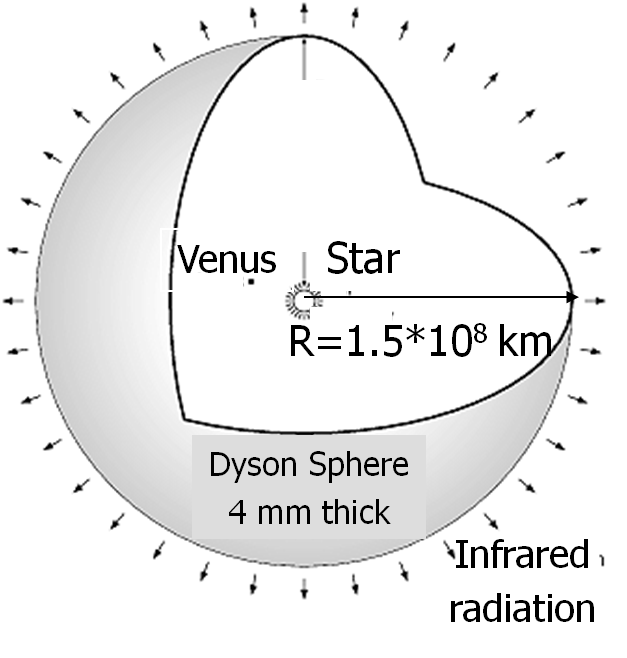
There is another possibility that is only barely mentioned in passing and only half seriously. What we might be seeing is evidence of an artificial construction called a Dyson Sphere. The idea being that stars put out a lot of free energy and that if an advanced race built a shell around it they could collect all that light and use it for some super advanced purpose.

Needless to say, I hope we have found evidence of an alien civilization that has somehow found a way to survive all the natural and self-inflicted wounds an uncaring universe can throw on an intelligent lifeform. I'm not looking for some event that knocks humanity out of its tried and true combination of ignorance and apathy. Just a flicker of some awareness that we are not alone in the universe could be enough to defer our appointment with extinction.

One final note, as of this writing the Allen Telescope Array is even now scanning KIC 8462852 for signs of artificially generated radio signals. No, I'm not optimistic but when you're playing this type of game patience is a vital element in this research.

Tuesday, March 3, 2015

Out of This World Real Estate


Unbeknownst to the majority of Americans a NASA spacecraft named Dawn is even now slowly approaching the dwarf planet Ceres preparing to enter orbit around that mysterious body floating in the void between Mars and Jupiter. This would normally only be important to planetary scientists and civilian space geeks like me since most bodies in the asteroid belt are about as exciting as the average Idaho potato, curiously something they strongly resemble.

Not Ceres, it is the largest body in the asteroid belt, roughly the size of Texas, with a significant portion of its mass consisting of water ice. There are also strong hints that it may harbor a subsurface ocean like the Jovian moon, Europa is thought to possess. For several decades in the ninetieth century, it was actually classified as a planet before some grumpy scientists got together and busted it down to glorified space junk.

Up until a couple of days ago the boys and girls at NASA seemed to be preparing for the usual science nerdfest as the Dawn spacecraft closed in on Ceres, then something fairly weird happened. Two bright spots appeared on the surface centered inside an impact crater. Now, “bright spots” are a relative term since in actuality Ceres is as black as a lump of coal but still the appearance of these two highly reflective areas has sent everyone involved with the project into a tizzy.


More than likely what Dawn spotted is the eruption of some sort of ice volcano, absolutely scientifically cool since that would mean that there is a subsurface ocean of liquid water. That alone would make the astrobiology crowd extremely happy since the general consensus is that where there is liquid water, some form of life could exist. Given Ceres location in the solar system it would be far easier to send another probe to it than try and land on Europa and then somehow penetrate several miles of ice to reach its ocean. The bad news for any possible lifeforms native to Ceres is that circumstances will eventually make it a valuable piece of real estate.

No, I didn't suddenly have a nasty, unplanned acid flashback that caused my brain to phase out from reality. See the asteroid belt has millions of rocks of various sizes floating around waiting for someone to come claim them. Why would anyone want one of these leftover pieces from the formation of the solar system? Because a good number of them are made up of iron, nickel, and other rare and extremely precious metals. John S Lewis,author of Mining the Sky, has done the numbers and says that an asteroid one-kilometer in diameter would have a mass of about two billion tons and consist in part of about 30 million tons of nickel,1.5 million tons of metal cobalt, and 7500 tons of platinum. The platinum alone would be worth about 105 billion dollars. All told the mineral wealth in the asteroid belt could amount up to 100 billion dollars for each person on Earth.

Yes, going into space to claim and then begin processing asteroids for their metals has been problematic for several reasons but just two have been the real show stoppers. The first being that while precious metals are becoming rarer on Earth we haven't quite exhausted every source here. Although, the demand for these metals is growing exponentially with no end in sight. The second reason has to do with a dependable source of water and that is where Ceres comes into play. The water on Ceres could be separated to provide hydrogen and oxygen for fuel for spacecraft for both exploration and the return trip home to Earth. The water on Ceres would also be used in life support systems for any possible base built on the surface and for manned spacecraft.

None of this will happen overnight, currently purposed asteroid mining plans have everything done by robot probes but these are all small scale ventures. It is not hard to foresee a scenario where production is quickly ramped up with humans having to be on-site to oversee operations.

Some have mixed feeling about humans spreading out into the solar system. They have compared us to locust or viruses and you can't really argue with their point. Since the advent of civilization we have just about ruined the planet with our numbers, wars, and pollution. Others like me see the possibility of asteroid mining and other space-borne industrial operations as away to lessen human impact on a gravely injured planet. Whatever the case, unless we blow ourselves up sheer pressure from resource depletion will eventually push someone into space to take advantage of what is just floating around in the void.

Sunday, July 21, 2013

Cosmic Questions of Alien Mice and Men


One of the joys I had growing up in Georgetown, South Carolina that extended well into the 1980’s was the ability to go outside and see the stars of the Milky Way scattered across the sky at night. Of course these very impromptu observations were before both urban sprawl forced a huge jump in nighttime illumination for safety reasons and damn suburbanites developed the narcissistic need to show off their carefully tended lawns with landscape lighting. Such is the nature of childhood I guess that something so simple and pure can literally be lost in the glare of what some call progress. Truthfully, I cannot blame progress all that much, while my hometown was a very pleasant place to live it would have only been a matter of time before one of the newer neighbors called the sheriff on my ass accusing me of being a peeping tom.

It would be a supreme understatement of criminal proportions to say those quiet nights watching the stars were awe inspiring. In truth I actually felt privileged to be able to see the majesty of creation wheel before me. Couple that with Carl Sagan’s show “Cosmos” that aired about the same time and there were times I could stand outside looking at the stars and almost hear his words describing the birth of the universe.

One of the problems of being overly curious is that you cannot stand outside looking at night sky for any length of time and being to wonder if their might be sentient creatures like us living on alien planets circling those distant stars. The next natural step, fueled by science fiction both good and bad, is wonder if maybe these other intelligent species might be advanced enough to travel the almost unimaginable distance and come visit our small but hospitable world.

Saying that such journeys would be difficult is a monumental understatement and to be fair there are a number of respected scientists that say manned interstellar travel is simply impossible given the energy requirements needed to accelerate even a relatively small mass object close to the speed of light. For them any possible interstellar community would be restricted to a galactic internet with various species broadcasting radio messages to each other, then waiting the centuries, if not millenniums, for a reply.

Of course this stay-at-home attitude ignores such possible propulsion technologies as nuclear pulse, fusion engines, antimatter drive, and the really wild ideas for surfing space-time itself which, some say, would allow us to break Einstein’s law about not traveling faster than light. Except for nuclear pulse, which was actually tested on a very small scale in the 1960’s, all of those possibilities are for the foreseeable future just theoretical curiosities. Yeah, it bugs the living shit out of me.

Not surprisingly there is intense debate among the stay-at-home crowd and those like me who would jump at the chance to “explore strange new worlds.” The former likes to bring up Fermi’s Paradox which says that given the high probability that there are at least a few other intelligent species in the galaxy if interstellar travel was possible even a relatively slow starship, say going just ten percent the speed of light, should have visited already. In other words, even at an interstellar snail’s pace it is possible for an adventurous species to explore the entire galaxy in just a few million years. Yes, the rocket scientist boys and girls have checked the numbers on that one.  

The obnoxious stay-at-homes also like to point out that Earth was prime carbon-based lifeform real estate for billions of years and should have been snapped up by at least one colonizing species. Furthermore, given that complex life has existed on this planet for millions of years if any alien Jim Kirks had stopped by they should have left examples of their visit in case intelligent life ever evolved. Now the stay-at-home get vague here, and never really state what type of evidence any possible aliens might leave. Just off the top of my head some of the junk they might have left behind could be a few burned out warp drives, mounds of alien trash including poo, and just maybe the occasional crewmember left marooned on an airless moon because it would not stop farting on the bridge.

Frankly I am in the Star Trek camp who believes all the stay-at-home are unimaginative poopoo heads. Interstellar propulsion technology is not even in its infancy and while it will obviously be too expensive for nation-states to pursue alone there is simply just too much promise to abandoned research when the human race could end up with the chance to explore the galaxy. Unfortunately, even if we get the chance to “seek out new civilizations” the basic principles of evolution preclude the possibility of someone playing James T. Kirk and bagging some smoking hot green-skinned Orion babe. Yeah, you can probably begin to imagine what my childhood was like but don’t go there.

Now there is sort of a bridge between the Star Trek types like me and the aforementioned unimaginative poopoo heads. The idea is that even if manned interstellar travel is impractical bordering on impossible an adventurous species could send self-replicating probes on the long and very slow journey. Once these robotic emissaries arrive at a promising star they radio back what it has found and then go about building copies of itself which in turn begin the journey all over again.

From Phy.org, posted July 19, 2013:


Now even this compromise opens up its own can of alien face hugging worms. If alien robotic probes are hanging around our solar system wanting to make contact with us hairless primates what are they waiting for? The disturbing idea I cannot shake is that they do not consider us an intelligent species, and who in this great big wide cosmos would blame them? Even hamsters know not to make a mess of where they live and do not get me started on humanity’s other sins.

Secondly, it only takes one Nazi-like alien species suffering from paranoid delusions to send out fleets of self-replicating destroyers whose only purpose is to listen for other intelligent lifeforms leaking out television broadcasts of their versions of The Tonight Show or I Love Lucy then drop by their home planet and nuke the living daylights out of them. Think I am crazy? First, my mother had me tested and second even Stephen Hawking has said pursuing alien contact might be a very bad idea.

In my opinion humanity making first contact with another intelligent species might be the best thing that ever happened to us. It might just be what is needed to make the bulk of our species realize there is more to existence than just our civilization’s perpetual idiotic games of empire building, destroying the environment for a buck, and some nation making an attempt at global domination.

The incident that sticks in my mind though happened to me on was on one of those star gazing nights back in my hometown. It was during one summer night after a particularly bad thunderstorm had knocked out power to the neighborhood. The storm cleared out quickly leaving my backyard almost pitch black and the stars an unimpeded stage. Looking through my granddad’s old army binoculars I had gone into serious geek mode after catching the sight of Jupiter and at least three of its Galilean moons.

My reverie was destroyed when out of nowhere I heard someone shout, “What the Hell are you doing boy?”  Out of the darkness emerged a man I called “Uncle Boo”, he had heard someone talking to themselves and came over to see what sort of fool was outside after a thunderstorm. Uncle Boo literally scared the Hell out of me, it was like he came out of nowhere. Once I explained he went back home and got his own telescope and we spent about an hour looking up at clear night sky before the lights came back on. While these days nighttime illumination prevents me from seeing the stars like I use to but I still look up and like Enrico Fermi, who was one of the smartest men of the twentieth century, wonder where in the Hell everyone is, or if  they are lurking somewhere out in the darkness watching us, or if maybe they are all hiding from something. 

This is for those damn Stay-at-Home shitheads.