Showing posts with label SETI. Show all posts

Sunday, November 29, 2020

Arecibo-- A Disastrous Loss to Science and Humanity


Arecibo in better days

When news footage of the disastrous 2019 fire at Norte-Dame cathedral made worldwide news I was sadden and shock like most people. Setting aside its religious significance, Norte-Dame is an important part of our common human heritage, something that needs to be rebuilt and preserved for as long as possible. I'd say the same for the Great Wall of China, the Pyramids of Egypt and Central America, Stonehenge, the Parthenon of Athens, or any other historically important structure.

So it was a bit of gut punch that I recently learned the giant radio telescope at Arecibo, Puerto Rico has suffered through catastrophic failures of two of its main support cables and will be permanently closed. The remaining cables are still holding up the 900-ton scientific package platform that over the years helped detect numerous near-Earth asteroids, the first exoplanets, and other phenomena. Back in 1974 astronomers even used Arecibo to send a coherent and intentional message into deep space in hopes an alien civilization on some distant star might hear it.

Built in 1963, the Arecibo telescope has undergone numerous upgrades and continuous maintenance but appears that simple time and climate got the best of it. However a 6.4 magnitude earthquake in 2014 and Hurricane Maria in 2017 were sure to have pushed the aging structure closer to the breaking point.

It's damn tragic that such an important scientific instrument that lead to many groundbreaking discoveries will now be abandoned. Just Arecibo's work on detecting near-Earth asteroids and the dangers they pose to the planet and human civilization should be enough to have it rebuilt. Excuse me, but I do feel losing Arecibo is akin to the fire in Norte-Dame. In many ways I feel Arecibo was a scientific cathedral that instead of bringing us closer to God, helped humans understand the nature of the universe we live. 


,
The Arecibo message sent out in 1974.


Source:

Legendary Arecibo Telescope Will Close Forever, and Scientists Are Reeling: Scientific American

November 19, 2020

https://www.scientificamerican.com/article/legendary-arecibo-telescope-will-close-forever-and-scientists-are-reeling/

Sunday, August 2, 2020

Maybe It's Aliens, If We're Lucky?


You know we live in interesting times when legitimate reports involving UFO's hit the mainstream media and they aren't the top stories in the evening news. But that is the case with both a New York Times report and the one Huffpost uploaded on their webpage.

On the surface both reports sound like the usual highly dubious and easily dismissible stories espoused by countless nutcases and con men for decades. The trouble though is that this time we have official statements from both the U.S. Navy and the Pentagon that yes, there have been sightings of strange aerial phenomenon displaying capabilities outside the abilities of current technologies.

More to the point, a few years back the Pentagon once stated that its covert program to study unexplained aerial phenomenon had been disbanded. Now real news outlets have discovered that this program was just renamed and moved to the Office of Naval Intelligence. Not exactly something an organization would do if there wasn't a reason to keep information hidden.

Those reason appear to be that these unknown craft have the ability to perform extreme maneuvers that defy known physics. One such unidentified vehicle was observed dropping from 60,000 feet to 50 feet in a matter of seconds. You don't need a degree in physics nor human anatomy to understand such maneuvers would destroy any known craft and turn any human pilot to chunky salsa.

Despite the possible crazed hoopla about aliens and first contact scenarios the more chilling possibility revolves around either Russia or China secretly developing technology that puts out best, most advanced planes on par with WW2 aircraft. Why Russia or China as possible boogeymen? Because they are the only countries with the money and/or technological clout to make such a breakthrough.

For the most part I despise Russia, but they do produce some seriously world class engineers and theoretical physicists. Their one drawback is money, it's one thing to produce fancy blueprints and maybe a prototype. It is another to have the money and industrial capabilities to turn such dreams into reality. China on the other hand does have the money, engineers, and the industrial might to possibly produce such revolutionary aircraft. What both countries do share is a grudge against the United States and an overwhelming desire to be the global top dog and remake the world pecking order.

Another possibility worth mentioning is that this release of information about UFO's is just a disinformation campaign by the United States Government. That our country has actually made a massive breakthrough in aviation technology and that we are just acting stupid to throw off our adversaries. Such possible advanced aircraft have to be tested and with surveillance what it is these days someone is bound to catch sight of these vehicles. At least that is my best case scenario when it comes to this situation.

Touching back on aliens, no I do not believe these UFO's are extraterrestrial in origin. The idea that an advanced alien race would travel hundreds, if not thousands of lightyears just to play aerial chicken with the primitive natives is just a bad science fiction movie idea. I've got admit though, given how supremely nightmarishly fucked up 2020 has been, we probably can't discount Little Green Men entirely.

See:

Explosive UFO Report In NYT Mentions ‘Off-World Vehicles Not Made On This Earth’

Saturday, March 17, 2018

Galactic Musing


One of the few advantages I had growing up in a semi-rural area of coastal South Carolina was the relative darkness of the night sky. Up until the early 1980's it was possible to step into my grandparents' backyard at night and be able to see the wispy Milky Way stretching across the vault of heaven. For a science/science fiction nerd like me the sight of all those stars made any human-made art, both religious and secular, pale into utter insignificance. Adding to that sense of wonder, with just a pair of WW2 surplus binoculars, I was able to see Jupiter as a tiny disc with its four major moons as pinpricks of light dancing around it.

It was during those quiet nights of observation, I would wonder about what planets might circle those nearby, but impossibly distant stars. Better yet, fed from a growing number of science fiction novels and movies I imagined all manner of strange intelligent species that just might have individuals looking up into their own night skies and ponder about who they might share the galaxy with. This during a time long before the actual discovery of exoplanets and with some astronomers still speculating that planetary formation might be quite rare in the greater universe. 


Literal decades have passed since I have been able to satisfy my innate desire to stargaze. The culprit being light pollution caused by massive urban and suburban sprawl. In fact in the mid-1990's my wife bought me a fairly decent telescope with hopes that I would use it in our own backyard. But after a couple of tries it became apparent that light pollution from homes, street lamps, and even the nearby city made any acceptable viewing impossible. Yes, I looked into joining the local astronomy club but I couldn't juggle the demands of a newborn baby, required overtime at my civilian job, and National Guard duties with the nights that group got together.

So that telescope ended up being stored in the attic and more or less forgotten about until it wound up being sold at one of my wife's yard sales. She never could understand the concept of how light pollution screwed with nighttime viewing. Then there was the nasty fact that suburban inhabitants start to get nervous when they see someone in their backyard with a telescope. Most people are so disengaged from the natural world they find it exceedingly difficult to understand that looking at the stars is an actual pastime.

At least my wondering about other intelligent species on planets circling nearby stars has been answered to a certain degree. Decades worth of SETI scanning of nearby stars strongly suggests that there isn't a technical civilization in our immediate area. Carl Sagan pretty much quashed the idea that there could be two intelligent species with a similar level of technological achievement existing “close” to each other. That a whole host of factors would assure that one species would be far more advanced than the other. That means that while there could be an intelligent species existing on a planet orbiting any number of Sun-like stars in our stellar neighborhood, they're probably still figuring out how to make fire, at best.

Yes, there is a remote, non-zero, possibility an incredibly advanced alien civilization might live nearby but there isn't any evidence of their existence. No Dyson Swarms of solar collectors orbiting the home star soaking up free photons, no laser beacons flashing out “here we are” in an attempt to get noticed, and no simple radio or embarrassing television broadcasts leaking out to the galaxy. You can endlessly speculate about hyper-advanced technologies like the fictional subspace for communications or that they are hiding from us using cloaking devices to avoiding upsetting the primitive and irrational hairless primates. But along those same lines you might as well hypothesize about a real Santa, Toothfairy, or Easter Bunny.

Don't get me wrong, while UFO's are a total nonstarter with me, I fully believe that alien civilizations do exist somewhere in our galaxy right now. The last reasonable article I read suggest that after crunching the numbers the nearest one is probably under two-thousand lightyears away. I don't have any idea how many stars exist within that distance of Earth, but within just fifty lightyears there are 133 of various magnitudes.

But even with suburban stargazing ruined for me, there is a way I can get my dose of awe and wonder about the universe. Occasionally amongst my aimless drifting on the internet, I will find a picture that metaphorically blows me away. One of the best is below and it's a panoramic view of the Andromeda galaxy. It's a spiral galaxy like our own and is “only” two-million lighyears away.

I can look at this picture and once again wonder about intelligent creatures two-million lightyears away sitting in their home looking at photographs of our galaxy wondering if anyone lives there. Before anyone flips out, yes, the light we see from the Andromeda galaxy took two-millions years to reach our eyes and electronic detectors. So we're essentially looking that far back into the past. But with that much real estate you got to wonder that at least one of those stars hosted the evolution of an intelligent species. 

Click on the picture to enlarge.

Sunday, January 14, 2018

Sufficiently Advanced


Art by Rene Aigner, Click picture to enlarge.

"Any sufficiently advanced technology is indistinguishable from magic."
Arthur C. Clarke


 Albert was the one who brought up the idea of making a side trip to Yeager Air Force Base. About five members of our group were outside the darken motel we had taken refuge, sitting around a campfire built in the middle of the parking lot. We didn't need a fire, it was still warm enough to sit outside without building one. In fact some in our group relished the ability to see the stars without dealing with the now gone light pollution from countless buildings and cars. But the fire served a more primal purpose, it called to the human need for safety and togetherness that stretched back to the beginning of our species.

A little over a year had passed since the event our small group of twenty-nine people collectively called the Disappearance had occurred. As a rule we rarely talked about the event or what our lives were like before it. I truly don't think the couples that naturally formed as we came together talk about it amongst themselves in private. The event so violated our concept of reality that to acknowledge it would be like surrendering our sanity.

“I served at Yeager for over five years.” Albert said while staring at the fire revealing more about himself with that statement than in the five months since I linked up with them. “I was a satellite photo-reconnaissance specialist, my group could redirect any of the assets we had in orbit and take clear, detailed pictures of everything from the license plates of Russian military vehicles to women sunbathing naked on the beach.”

Albert an African-American male in his late twenties who, like the other survivors, joined the group seeking the reassurance and companionship everyone desperately needed in the wake of what had happened. To me, he seemed a little nerdy, especially since I noticed he was constantly taking measurements of the weather conditions and keeping it logged in a journal.

“Why are you telling us this, Albert?” Cynthia asked in her normal irritating manner. I really didn't care much for her, Cynthia was in her late fifties and one of those upper middle class hippy types who threw hissy fits about gluten and GMO veggies in the grocery store. Now, she complained about not having the benefits of civilization like electricity, running water, taking a relaxing crap inside a warm house, along with instant access to her psychiatrist.

Albert took a deep breath and used a stick to poke the fire before saying anything. “There's a chance I can get the emergency generators working and with power I can download the stored data in the satellites. That way we could see what happened on that day.”

I didn't say anything at first. Our group was camped for the night at one of those motel/restaurant/gas stations conglomerations just off Interstate 40 outside Oklahoma City. Our destination was Willow Creek, California where a group of about 600 west coast survivors had begun to assemble. If the short wave broadcasts we had with them were true, the small town had access to electricity supplied by a combination of windmills and hydroelectric power.

Albert's idea was intriguing and if our group didn't consist of nine kids from the ages of three years-old running up to a pregnant girl of fifteen, he and I would definitely go check it out. But Agatha Higgins, more or less our leader, would not be keen on the side trip. Being a pediatric nurse before the Disappearance, right now her life was dedicated to getting the kids to Willow Creek before another winter hit. The price the rest of us adults paid for riding along was unqualified support of Agatha's efforts.

“Gregg is the person I'd talk to about that idea, Albert.” Wilson Banner said while sitting next his partner. “Agatha is in Jean's room watching over her, so there's little chance she would pay you any attention.” Jean was the fifteen year-old pregnant girl who Agatha was watching like a hawk given her age and condition. With Agatha preoccupied, that would allow Albert and myself a straight shot at Gregg.

If Agatha was the leader of our group, Gregg Mason was the second in command. He also held the position as Agatha's love interest. Given the nature of the Disappearance, it goes without saying that their relationship didn't start until after the event. They were a curious couple, Agatha was a statuesque black woman in her forties almost supernaturally dedicated to the welfare of children. Whereas Gregg was a short, truly ugly white guy of about the same age possessing the talent of coaxing in all things mechanical back to life. Like I said, we really didn't talk about our lives before everyone disappeared so no one really knew how they came together in the aftermath.

While still not saying anything directly to Albert that I had a growing desire for this trip to happen, I follow him up the outside stairs to the second level of motel rooms we had taken. It wasn't late but as Albert and I passed the open rooms occupied by the kids, we could tell they were asleep. Something that came naturally to us all really with electricity now gone.

We found Gregg wide awake in he and Agatha's room sitting at the desk next a battery-powered lamp going over a ledger, probably a list of our supplies and what we should look for along our travels. Albert quickly spelled out his idea and how he could possibly bring the satellite control center back to life.

“So you want to do this as well, Rick?” Gregg asked me as he reached for a bottle of Gatorade on his desk.

“Yeah, I'd like to know just what in the hell happened that day.” I replied. “Albert can't do this by himself and then there's the question of security.”

That question went both ways, the one element of my life that everyone knew about was that when the Disappearance happened I was a staff sergeant in the United States Army stationed at Fort Jackson, South Carolina. After linking up with Agatha, Gregg, and the others I essentially became the chief of security.

Along the way after that I had played a big role protecting the kids, mainly from dogs that had gone wild and from a small group of lions someone had obviously let loose from a zoo. Luckily, a few rounds fired in their general direction from the .50 caliber machine gun mounted on the roof of the Humvee I drove sent them running. The world was clearly up for grabs with humans now an endangered species, but I didn't want to kill those beautiful animals.

“Do you think Ralph and Laura can fill your shoes?” Gregg asked about the two people who more or less worked under my command.

Both had served in the military and I found that I could honestly answer yes to Gregg's question. As long as they could tear themselves away from each other. The two screwed like sex starved rabbits when not on duty.

“Then take one of the SUV's and go,” Gregg said instantly. “We all hope Willow Creek is the promised land but if you get those satellites up I want you two to look the place over.”

***

The trip to Yeager Air Force Base sucked about as much a journey can without someone getting killed. Before the Disappearance it should have taken two days at best to cover the distance from Okie City to the outskirts of Colorado Springs. Instead it took six with Albert and myself stupidly deciding to cut across old U.S. Highway 87 which ran between I-40 and I-25, which then took us into Colorado Springs. Turned out US 87 had been washed out in numerous spots since the Disappearance and then there was the problems with finding supplies.

For those of us remaining on Earth after the Disappearance, life revolved around foraging the leftovers of civilization. As we passed through the dozen or so small towns on our route, we found nearly all the gas left in the underground storage tanks contaminated. That required us to use the technique Gregg developed to filter out the water, which took hours. The grocery stores, reeking of decaying meat in the dead refrigerators, still held plenty of canned and packaged goods but it was clear another bunch of survivors had already passed through going God knows where.

We finally arrived on the outskirts of Yeager on our sixth day and quickly found the building that housed the satellite control facilities. Given my army background, I somehow expected Cold War era/Terminator movie-style harden bunkers with twenty-ton steel blast doors. While the actual control facilities were in an obviously well guarded subbasement of the building, the place reminded me more of a commercial call center than military redoubt.

The real fun began as Albert lead me through a long series of pitch black access tunnels to what he called “one of the emergency generator rooms.” We both carried several spare flashlights, but the entire time we were down there I realized that if they all somehow died getting back out would be a near impossible task.

Luckily, Albert easily found the door to the generator room and just when I was about to ask him how we would get inside he began typing something on the recessed keypad next it. The sound of a loud click followed by the door opening slightly and lights coming on inside the room itself was deeply reassuring.

“Albert,” I begin whispering for no reason I could think of, “just what in the hell were you in the Air Force?”

“Honestly,” he replied while walking over to a control panel that looked like a piece of the bridge of the starship Enterprise, “satellite reconnaissance specialist like I said. But after leaving the Air Force with the rank of captain, I worked at the NSA.” He finished obviously happy with the stunned look I had on my face.

“Jesus dude, you could have told me you were an officer.” I say upset since his quiet demeanor with the group and on our way to Yeager suggested he was at best a NCO like myself while in the Air Force.

“No worries,” he tells me while working through a complex array of commands on two different computer screens. “You're an experienced infantry soldier while I never even slept outside more that two nights in the service. One of my worst struggles during those years was being deployed to Afghanistan for six months and having to eat at an army mess hall.”

Whether Albert was telling the simple truth or attempting humor I had no idea. Although, I could understand, army mess halls were crap when compared to Air Force cafeterias.

About an hour later we walk into the now fully functional satellite control room. Now it was everything I imagine with giant video screens showing maps of different sections of the planet in front of several long rows of computer terminals sitting side by side.

“So it's this easy to gain access to a highly classified government facility?” I ask Albert as he takes a seat at a supervisory terminal.

“Not for anyone who shouldn't be here in normal times. The system was designed with multiple redundancies in the event of national emergencies so proper personnel could bring it back up. But I admit, having the vast majority of the global population simply disappear was not one of the scenarios they envisaged.” Accessing the satellites and downloading the stored data took longer than Albert expected. He blamed it on an operating system upgrade but eventually he was able to show the end of the world.

The data was completely anticlimactic compared to what those of us who lived through it on the ground. From the perspective of the satellites, planes fell from the sky and all telecommunications stopped at the same moment. Of course the electric lights of cities seen from the night side of the planet stayed on anywhere from several hours to a couple of days but even they died. We found absolutely no reason for the Disappearance, no orbiting alien space ships harvesting unsuspecting humans nor an army of winged angels whisking worthy souls up to heaven.

Silently Albert continued to scan the downloaded data and even redirect satellites in an effort to get an idea on what the rest of the world was like before the power died. He even got several high resolution scans of Willow Creek and intercepted a couple of radio broadcasts local to the area. At least it was turning out to be the sanctuary Agatha, Gregg, and everyone else hoped.

As the hours passed, I had long since wandered off searching for food when the building intercom screeches to life. “Rick,” Albert's voice yells through the speakers, “get back in here, I found something.”

***

We were three weeks into Mexico driving to a totally middle-of-nowhere spot in the state of Durango when I begin to doubt the sanity of both Albert and myself. While the post-Disappearance weather and years of neglect before that had taken their toll on American roads, those in Mexico were even worse. Backtracking became a hellish daily activity, along with foraging fuel and food from locations we were simply not familiar. But somehow we made progress with an Air Force GPS device we stole from the base slowly ticking closer to our destination.

We first saw it at a village we camped at several miles away. It was just an unimpressive bump on the horizon but given that we were a good distance from the nearest thing that could be called a city, it was a large structure that had no business existing. It wasn't the only one on the planet, Albert had fished around with the satellite surveillance data and discovered bizarre large structures appearing on every continent the same time most of humanity vanished. What gave them away were the satellites recording extremely high electromagnetic radiation emissions when they popped into existence, then nothing.

The structure we were about to visit was North America's. The one for South America was almost dead center in the Amazon rain forest, while Europe's was in Hungary. Asia got two, one in eastern Siberia and the other in northern India. Africa had two as well, with the northern one just a few dozen miles from the Giza pyramids and the other in the jungle of southern Congo. For a reason I couldn't describe that seemed almost funny, Australia's missed the entire continent and was located on the island of Tasmania. Even Antarctica had one near the South Pole, its function more of a mystery than the rest since there were so few people on the continent.

Neither of us said anything the next morning as we started the final leg of our long journey. The structure slowly grew higher and larger as we traveled across the desert plain. I'm not sure about Albert, but I expected some sort of activity as we approached. I believe the lack of any response filled me with a dread far worse than if the structure had been guarded by murderous aliens or rage-filled demons.

I stopped the vehicle just a few dozen feet away from the structure. It was rectangular in shape standing over thirty-stories tall with the four sides about forty-five to fifty feet wide at the base. Looking at it just a few feet away, it appeared to be a crudely cut block of stone. Pictures of ancient Stonehenge came to mind, except that this was far more massive. Then there were the vein-like filaments running up and down its length that coursed with a pale blue light. The structure was so alien, so utterly unearthly the reptile part of my brain wanted to drop everything and runaway. It took a conscious effort to walk towards it for a closer examination.

Albert on the other hand was enthralled, obviously the structure appealed to his highly analytical mind. He was already touching it while I was still deciding whether or not to flee.

“The Sentinel,” Albert said touching the structure.

“What are you talking about?” I ask edging closer.

“Remember the movie 2001: A Space Odyssey, the monolith that appeared to the hominid creatures and the one on the moon and later in orbit around Jupiter.”

Albert was right, while the structure wasn't a dead ringer for Arthur C. Clarke's fictional monolith, the one in front of me sure as hell was even more enigmatic.

“A shape for something that had no shape,” I said repeating the lines from one of the characters in the sequel made a decade or two later. That's when I snapped, my mind was flooded with memories of a wife I lost to pursue my military career and my seven year-old son I probably held less than ten times when he was a baby. With no apparent culprit to hold accountable for their disappearance, I had put all the emotions and guilt I felt towards them in a box and pushed it away. Seeing the monolith in front of me caused that box I wanted to ignore and forget about to explode.

“Rick, what the hell are you doing?” I vaguely heard Albert say before I grabbed the pickaxe from inside our vehicle and started taking swings at the monolith. Albert tried to stop me after the first swing but I pushed him away.

While my first swing glanced off the side of the monolith, on the second the pick dug deep into stony material of the monolith. In fact, a rather large chunk broke off and fell to the ground. That's when everything really went to shit.

***

I'm not sure what happened all I know is that everything went both totally dark and utterly silent. Hell, during that period I don't even know if I had a body. What I do know was that I could sense the presence of numerous powerful minds or just one massive entity. Truthfully they seemed to merge, split apart, and then repeat the process. Attaching human equivalencies would be ridiculous but I would guess that is how they communicated with each other. They didn't try to communicate with me, if one thing is certain I was less to them than bacteria are to us. But somehow my fear and anger affected them much in the same way bacteria can make us sick. They had to neutralized me to prevent their monolith from being damaged further.

What these entities did though was allowed me to sense some minuscule portion of their existence. The first thing I could discern was that the monoliths weren't things that allowed shapeless beings to have a form. No, the best human term for the structures would be that they are test leads or probes used to measure not just physical conditions like heat and humidity, but all life and how it interacted.

Earth was an experiment to them, whether their endeavor was planned out from the birth of the solar system or that they noticed the conditions of the young planet met their needs and decided to make use of it, I have no idea.


What I could tell was that our concepts of good and evil held no meaning to them. They aren't heavenly beings but neither are they purposely cruel, it gets back to the same way we humans look at bacteria. Yes, they are responsible for the Disappearance, and I don't know if everyone they took was erased, stored away like music on a CD, or now safely living in some paradise-like realm. I did learn that it was pure accident that some of us were left behind, their abilities and technology, hell their very reality are all way beyond our comprehension but they're not gods.

At some point those beings released me, because just as suddenly as everything went dark I found myself leaning on the monolith with Albert asleep inside our SUV.

***

“You were gone for over five hours,” Albert tells me after I crawled over to the SUV and woke him up. Now that I was back in the world, my body screamed my time away was much longer. I felt like I haven't eaten in days which is only surpassed by my thirst.

“Where did you go, Rick? Did you meet the beings that made the monolith?” Albert asks me as I finish off a second liter bottle of water.

We camped next the monolith for the night and I told Albert everything I learned. He in turn just listens saying nothing but somehow I could tell my experiences were concepts he already grasped. I finish by saying there was nothing we as a species could do to change the way the monolith entities view humans. They could easily wipe the remaining humans and the planet itself away. 

“I don't know about that,” Albert says looking towards the monolith. “The second you disappeared the blue light running through the veins stopped. I'd bet money you did that and the entities have disengaged from our planet.”

Just to be sure, the next morning I used the pickaxe to break off several more pieces of the monolith. Nothing happened, as far as this monolith was concerned, and I somehow knew all the others were just as dead.

With nothing left to prove or discover I just stood in front of the monolith staring at it. It was Albert who pulled me back to the world of the living.

“We're done here, Rick. Lets start heading back home to Willow Creek.”

Sunday, December 17, 2017

Oumuamua- The Epic Interstellar Traveller


 Forever on the lookout for science news stories to turn me away from the usual human-created crap, I have been in proverbial and literal heaven for the last several weeks. Back in October of this year, the astronomer Robert Weryk discovered a peculiar object that had passed through our solar system and was already on its way back out into the depths of deep space.

This object, given the name Oumuamua, meaning “scout” in the Hawaiian language is a metal heavy, cigar-shaped asteroid measuring 230 by 35 meters (that's 800ft x 100ft for metric ignorant Americans) that originated from an entirely different solar system. This was determined because of its course which had it entering the inner solar system at six degrees from the solar apex (the direction of the Sun's movement relative to local stars) and that fact that it was traveling like a bat out of hell as far as relative speed to the Sun is concerned. Traveling at 26.3 km/s, or 58,900 mph, Oumuamua is already halfway to the orbit of Jupiter and will eventually catch up and pass NASA's Voyager One space probe, the most distant manned-made object which is traveling about 17 km/s or 38,610 mph.

 Two things are really cool about this chunk of tumbling space metal. The most important, and scientifically real, is that it is the first confirmed object that came from outside our solar system. For those not grasping the concept, Oumuamua has been traveling for at least millions, if not billions of years between the stars. The distances and time involved for this journey are almost impossible for humans to fully understand.

The next reason is that Oumuamua has a really weird, cigar-shape not unlike theoretical models for possible rotating space colonies or even how movies and television often imagine fictional starships. The fact that its tumbling end over end and not cleanly rotating along the length of its axis gives Oumuamua a mysterious air, like it might be a long dead, derelict space ship for those with overactive imaginations like myself. If fact, the great science fiction writer Arthur C. Clarke wrote a book entitled Rendezvous with Rama where an object like Oumuamua is detected and does turn out to be a combination rotating space colony/ slower-than-light starship. The book set in the future where a type of solar system wide, semi-military space force exists, a human-crewed space ship is sent to intercept and investigate the alien-constructed craft. Whether of not the fictional Rama had a crew is, to me, a subject of debate since the beings the human explorers encounter are more than likely non-sentient robots programmed to maintain the apparently uninhabited ship.

Oumuamua weirdness has compelled real radio astronomers working for SETI to turn their equipment towards it in hopes of catching some type of artificial radio signals. Scientific American reports that they listened for two hours and came away with 90 terabytes of data. Nothing spectacular about that amount of data since most everything in space has a way to emit natural radio signals. Sorry folks, even with my overactive imagination Oumuamua is certainly nothing but a seriously epic rock on a voyage that will more than likely never end.

Despite the novelty of Oumuamua, astronomers are saying that interstellar objects like it passing through our solar system are a common occurrence. We just happen to be looking in the right place and at the right time to see it zip by. Still though, it is nice to imagine Oumuamua might be a stealth alien probe some mothership still way out in space launched in our direction to get a relatively close scan of Earth and the bizarre, semi-intelligent creatures that live on it.

I now return you to the regular self-destructive and banal crap that dominates our existence on this planet.

Sunday, August 27, 2017

Boldly Going


Pondering metaphysical concepts, without regard to crazy ass theories and ideas most normal people either discount or ridicule, is something I do many times in a twenty-four hours period, much to chagrin of my fuddy-duddy wife. While I've always been a person who likes to entertain ideas outside the realm of what normal people consider, when you work third-shift like me ruminating about the fantastic or improbable has the added effect of keeping my mind entertained.

Now, I also have to admit I'm particular about what I get metaphysical about, I don't waste my time on things like Bigfoot, alien abductions, UFO's that fly around trailer parks, anything about a literal Atlantis, or supernatural entities that terrorized little children and ruin real estate values. Long story short while I camp out in left field, most of my brooding is firmly on scientific grounds. I could carry on ad nauseam about my favorite subjects, like the possibility of life existing in the watery ocean under the ice of Europa, one of the moons of Jupiter. Another favorite is the future of Artificial Intelligence and how I'm ready to vote for a sentient computer to be president as opposed to the thing now living in the White House. And while I cringe when some bonehead brings up UFO's, I am always ready to discuss the current ideas about extraterrestrial intelligence and why Fermi's Paradox raises the hairs on the back my neck. PLEASE, someone ask me why Fermi's Paradox bothers me far more than it should. But remember I'm weird, marooned in a boorish suburban hell, and have no real life so my answer will be long, convoluted, and lean towards the fantastic.

But all that is for another day, right now I want to ponder the accomplishment of the Voyager 1 probe, which not only passed the forty year mark in its mission but is now the first human-made object to enter interstellar space. Launched back on September 5 of 1977 it flew by both Jupiter and Saturn before heading out into the abyss.
Due to a rather rare orbital aliment of the gas giants the planners back at NASA were able to leave the Voyager 2 probe the option of swinging by Uranus and then Neptune. For those not up on the orbital mechanics of “planets”, Pluto wasn't included on the Voyager Grand Tours because it simply wasn't in the proper position.

Which was all good because it allowed the wizards at NASA and the Jet Propulsion Laboratory to design, build, and then launch the New Horizons probe so it could specifically visit the little runt several years later. In fact during New Horizon's long voyage to its intended destination, the International Astronomical Union demoted Pluto from being a full-fledged planet to “dwarf-planet” status earning the the ire from its hordes of fans around the world while confusing the crap out of many Americans.

Personally, I think Pluto's demotion to dwarf-planet was a good thing. Any decent planet should be able to clear its orbit of all that primordial trash left over from the formation of the solar system. Then there is the fact that Pluto's orbit is highly elliptical, so much that it sometimes dips in front of Neptune's path. All told, I liken Pluto to the drunk, irresponsible redneck that moves his dilapidated trailer right next an upper-middle class subdivision. You know given this criteria, it suddenly just occurred to me that except for the dilapidated trailer and being a drunk, my neighbors could call me Pluto, or at least Ceres, another dwarf-planet that somehow sneaked into the better part of town.

Getting back on the proper metaphysical track, it should amaze every literate person that humans have made an object that is now sailing through interstellar space. The first reason for this is that it was only a little over a century ago that we hairless primates began making machines that could take us up just a few hundred feet into our own atmosphere. Yes, it will take forty-thousand years before Voyager 2 passes within a couple of light-years of a star (Ross 248) and then almost another three-hundred thousand years before it passes within four light-years of the star Sirius, but nevertheless a human-made object is traveling interstellar space. Given our rapid progress from primitive, propeller-drive aircraft made of wood and canvas to complex space probes speeding out of the solar system it isn't wrong to hope actual humans might be heading out to the stars at some point. That is if we don't destroy ourselves by allowing too many more delusional and narcissistic morons access to nuclear capable political leadership. 

Cover for the Golden Record


Which brings up the Golden Records each of the Voyager probes carry on board. Back during the planning stages of the Voyager probes a team a of scientists, lead by the great Carl Sagan decided to include a type of time capsule with each spacecraft should it be found by space faring aliens or even future humans. On these phonographic records are samples of music from around the world, greetings from different people in many languages, and different scenes of our planet. To help out any possible aliens or far future humans who might stumble across the Voyager probes the records are encased in a cover that gives “instructions” on how to play them as well as other nice tidbits of information about their planet of origin.

The mind blowing aspect of the Voyager probes and their golden records is that their expected lifespan is in the billions of years. While the chances of them being discovered by an alien civilization is so low it would be far wiser for a person to expect to win a multi-million dollar lottery, the Voyager probes are a testament to the vision and hopes of a difficult and troublesome species that on occasion could rise above its limitations. Needless to say, unless we Homo sapiens really clean up our act and get supremely creative, the Voyager probes could ultimately be the last thing in the universe that say we ever existed.

As someone who enjoys solitude way too much, I've got to say there is something chilling to think about all those countless millennia the Voyagers probes will sail through the void as our representatives. Makes me hope that one day some future intrepid human explorers will head out and bring them back home.

Sunday, July 16, 2017

More Alien Weirdness?


Not to get weird, because that ship sailed long ago, but as I was surfing the YouTube channels Sunday afternoon one of the guys I watch on a regular basis posted an interesting and out of the blue video. Turns out that the giant Arecibo radio telescope has detected an "odd" signal that seems to be coming from Ross 128, a red dwarf star about 11 light-years away.


Abel Méndez, an astrobiologist from the University of Puerto Rico said the star was observed for ten minutes, during which time the signal was detected and that it seemed "almost periodic". Méndez admitted that the signal could have originated from a communications satellite, since they often transmit on the frequencies observed but that the radio burst was "very peculiar". The video you will find below does suggest that if the signal was from a communication satellite it would have to be quite a bit farther out from Earth than is normal.


My first thought after hearing that was the signal might be from a spy satellite. Over the last several decades the United States and the Soviet Union have launched numerous secret payloads into space and I've heard a lot of crazy theories that some of them are in weird orbits in an effort to go undetected. There is also a chance that the signal came from the star Ross 128 itself, since red dwarfs often produce massive flares.


Recent speculation about that habitability of red dwarf star systems tends run either hot or cold. On the plus side, those stars live far longer that our sun, thus allowing a lot of time for life and intelligence to evolve, but those massive flares probably sterilize any planets orbiting close enough to be in their Goldilocks zone. Whatever the case, the guys and gals at Arecibo will be trying to tune in on Ross 128 in an effort to pick the signal up again.


Sunday, October 25, 2015

The Last Thing You Should Consider


Idle Speculations on Alien Intelligence and the star KIC 8462852. 


This is just a personal observation subject to error but as someone far more interested in the Search for Extraterrestrial Intelligence (SETI) than the average person I have noticed something over the last few years. While all the excellent and totally professional science guys and gals still say we are only now reaching the technological level that could allow us to gleam an artificial signal out of all the normal background static I sometimes detect a hint of uncertainty in their voices concerning their research.

Don't misunderstand me, I totally support SETI and do believe that our galaxy does host some number of intelligent, technological advanced alien species. The chief debate to me centers on just how many stars have planets that can spawn and then support for extended periods of time lifeforms that evolve into intelligent creatures. Current research suggests habitable planets are plentiful but whether or not the circumstances that allow intelligence to evolve and then survive are common is still a huge unknown.

For further, and sadly, just as needed clarification. NO, I do not put any stock in all the UFO reports and alien abduction stories that have made it to the popular media over the last fifty to sixty years. On the rare occasions I get to have an reasonable conversation about the possibility of intelligent alien life, someone nearly always chimes in about Roswell, Area 51, or some other tripe about UFO's and the government covering up their existence.

As much as I dream of manned interstellar flight being possible, right now it looks incredibly hard and so expensive it would take a truly prolonged global effort to pay for the project and build. We naked primates are still fighting over religion and whose nation is most special, the idea of us working together to cross the distance between stars is lubricious. Of course, a totally unexpected and out-of-left-field technological breakthrough could change the equation but that is just wishful thinking on my part.


Getting back on point, it seems some of the SETI folks are getting a little worried. For the last twenty years or so we have been scanning huge swaths of the galaxy and millions of frequencies and except for periodic false alarms and the rare and mysterious burp that doesn't repeat, come up with nothing. This has lead some in the biological sciences to suggest that complex life might be quite rare. They point out that while Earth has been around for over 4 billion years it was only 542 million years ago during the Cambrian Explosion that complex life appeared in the fossil record. Before that, all the evidence suggests that life on this planet was limited to single-cell organisms. These “Rare Earth” types argue that there are a complex array of interlocking conditions required before life can move beyond simple organisms and that if you remove a few from the equation further development is stymied.

Even if some complex organisms on an alien world evolves into an intelligent species there is a whole host of different disasters that might drive them extinct before reaching the technological point where they can hope to make their presence known to the wider galaxy. The late, and great, Carl Sagan speculated that all intelligent species might go through a cultural adolescence where their moral and ethical development is outpaced by their technological abilities. In short, they might nuke themselves into oblivion over inconsequential things like religion, nationalistic bullshit, resources, or whose penis is bigger.

(Important side note: Let me go on the record to state I not just talking about us arrogant Americans. At least here in the United States many of us blow off this “Exceptionalism” bullshit. I frankly find Russians more obnoxious with their ethnic based belief that their shit doesn't stink which is made worse by the chip they perpetually carry on their shoulder. It also appears that the Chinese harbor grand ideas of taking charge of the world and get quite upset when everyone doesn't go along with what they consider promotes harmony, which they define as anything that advances their national interests.)

It was the author and astrophysicist David Brin who in his book Existence upped the ante on intelligent species survival by mentioning there are a multitude of cosmic booby traps just waiting to cause an extinction level event for the members of any unwary civilization. These traps ranged from the known threats of a major asteroid or comet impact to being too close to a star going supernova or a passing neutron star. He also included “man-made” disasters such as a genetically created pandemic, the release of nano-sized robots that consume all matter, to climate disaster, which might be the one that already has our name.

Despite the fact that I am a huge fan of Neil deGrasse Tyson and his buddy Bill Nye I highly disagree with their skepticism when it comes to talk about the near-term human colonization of Mars. They tend to think colonization requires a planet with a breathable atmosphere, and while that would be nice such worlds are in short supply in our solar system. I would much rather deal with domed or underground cities on Mars if it meant the survival of the human race in the face of some man-made extinction event.

Long story short, when you take into consideration all the possible disasters-- or filters-- awaiting to befall intelligent species not only do they need to damn near be saints but extremely lucky as well to survive much beyond our current technological level. None of this bodes well for us humans looking to find other intelligent life in our galaxy.


Just speaking for myself, I was quite happy to hear last week that researches have spotted a strange star that does something none of the science types have ever seen before. The star, KIC 8462852, located about 1400 lightyears away dims in way never seen in any of the other stars observed by the famous Kepler orbiting telescope.

The Kepler space observator was designed to monitor the brightness of stars and detect when a body, such as a planet passes in front. Since its launch, the Kepler spacecraft has detected over a thousand confirmed exoplanets with some believed to be close to the size of Earth and orbit in the habitable zone of their parent star where water could exist as a liquid.

In the case of KIC 8462852 what has everyone buzzing is that Kepler detected two massive dips in the brightness of the star roughly every 750 days. One dimming event blocked up to 15 percent of the star's brightness with a later event blocked up to 22 percent. These changes in brightness are consistent with many small masses orbiting the star in tight formation. One thing seems to be clear, that whatever is causing this bizarre event is not a planet. Something the size of our Jupiter would only block 1 percent of our star's light. Whatever is blocking the light of KIC 8462852 is covering half the width of the star.

The overwhelming possibility of what we are seeing is either a cloud of disintegrating comets, essentially a bunch of massive balls of ice and dirty involved in a cosmic-level traffic pileup. Or a recently captured asteroid field kind of like the one Han Solo had to navigate through to escape the clutches of Darth Vader in The Empire Strikes Back.

KIC 8462852 does have a close by stellar companion that might have stirred up the cloud of comets that surround all stars, sending them crashing inward and after 1400 years of its light traveling our way screw with H. sapien astronomers here on Earth desperate to make a first contact with aliens. And while we believe it to be an older star it's possible KIC 8462852 is actually young and still has a lot of primordial junk floating around it. For this one I guess the best analogy would be your average teenager's room.


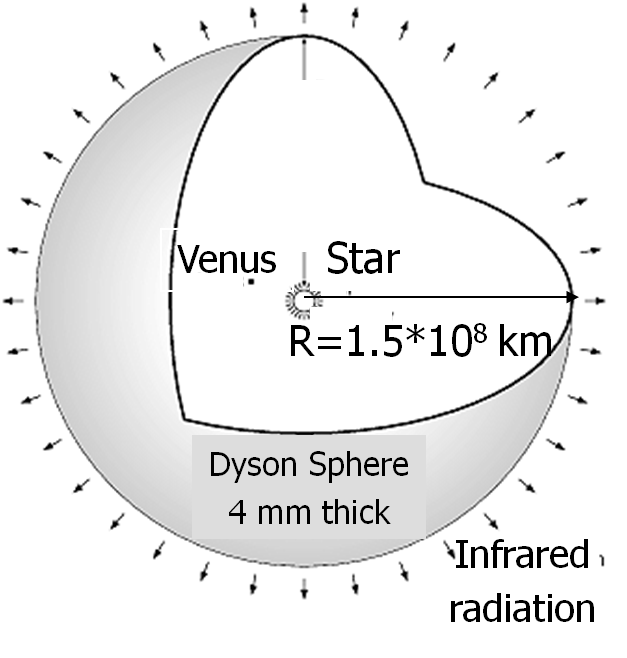
There is another possibility that is only barely mentioned in passing and only half seriously. What we might be seeing is evidence of an artificial construction called a Dyson Sphere. The idea being that stars put out a lot of free energy and that if an advanced race built a shell around it they could collect all that light and use it for some super advanced purpose.

Needless to say, I hope we have found evidence of an alien civilization that has somehow found a way to survive all the natural and self-inflicted wounds an uncaring universe can throw on an intelligent lifeform. I'm not looking for some event that knocks humanity out of its tried and true combination of ignorance and apathy. Just a flicker of some awareness that we are not alone in the universe could be enough to defer our appointment with extinction.

One final note, as of this writing the Allen Telescope Array is even now scanning KIC 8462852 for signs of artificially generated radio signals. No, I'm not optimistic but when you're playing this type of game patience is a vital element in this research.

Sunday, July 21, 2013

Cosmic Questions of Alien Mice and Men


One of the joys I had growing up in Georgetown, South Carolina that extended well into the 1980’s was the ability to go outside and see the stars of the Milky Way scattered across the sky at night. Of course these very impromptu observations were before both urban sprawl forced a huge jump in nighttime illumination for safety reasons and damn suburbanites developed the narcissistic need to show off their carefully tended lawns with landscape lighting. Such is the nature of childhood I guess that something so simple and pure can literally be lost in the glare of what some call progress. Truthfully, I cannot blame progress all that much, while my hometown was a very pleasant place to live it would have only been a matter of time before one of the newer neighbors called the sheriff on my ass accusing me of being a peeping tom.

It would be a supreme understatement of criminal proportions to say those quiet nights watching the stars were awe inspiring. In truth I actually felt privileged to be able to see the majesty of creation wheel before me. Couple that with Carl Sagan’s show “Cosmos” that aired about the same time and there were times I could stand outside looking at the stars and almost hear his words describing the birth of the universe.

One of the problems of being overly curious is that you cannot stand outside looking at night sky for any length of time and being to wonder if their might be sentient creatures like us living on alien planets circling those distant stars. The next natural step, fueled by science fiction both good and bad, is wonder if maybe these other intelligent species might be advanced enough to travel the almost unimaginable distance and come visit our small but hospitable world.

Saying that such journeys would be difficult is a monumental understatement and to be fair there are a number of respected scientists that say manned interstellar travel is simply impossible given the energy requirements needed to accelerate even a relatively small mass object close to the speed of light. For them any possible interstellar community would be restricted to a galactic internet with various species broadcasting radio messages to each other, then waiting the centuries, if not millenniums, for a reply.

Of course this stay-at-home attitude ignores such possible propulsion technologies as nuclear pulse, fusion engines, antimatter drive, and the really wild ideas for surfing space-time itself which, some say, would allow us to break Einstein’s law about not traveling faster than light. Except for nuclear pulse, which was actually tested on a very small scale in the 1960’s, all of those possibilities are for the foreseeable future just theoretical curiosities. Yeah, it bugs the living shit out of me.

Not surprisingly there is intense debate among the stay-at-home crowd and those like me who would jump at the chance to “explore strange new worlds.” The former likes to bring up Fermi’s Paradox which says that given the high probability that there are at least a few other intelligent species in the galaxy if interstellar travel was possible even a relatively slow starship, say going just ten percent the speed of light, should have visited already. In other words, even at an interstellar snail’s pace it is possible for an adventurous species to explore the entire galaxy in just a few million years. Yes, the rocket scientist boys and girls have checked the numbers on that one.  

The obnoxious stay-at-homes also like to point out that Earth was prime carbon-based lifeform real estate for billions of years and should have been snapped up by at least one colonizing species. Furthermore, given that complex life has existed on this planet for millions of years if any alien Jim Kirks had stopped by they should have left examples of their visit in case intelligent life ever evolved. Now the stay-at-home get vague here, and never really state what type of evidence any possible aliens might leave. Just off the top of my head some of the junk they might have left behind could be a few burned out warp drives, mounds of alien trash including poo, and just maybe the occasional crewmember left marooned on an airless moon because it would not stop farting on the bridge.

Frankly I am in the Star Trek camp who believes all the stay-at-home are unimaginative poopoo heads. Interstellar propulsion technology is not even in its infancy and while it will obviously be too expensive for nation-states to pursue alone there is simply just too much promise to abandoned research when the human race could end up with the chance to explore the galaxy. Unfortunately, even if we get the chance to “seek out new civilizations” the basic principles of evolution preclude the possibility of someone playing James T. Kirk and bagging some smoking hot green-skinned Orion babe. Yeah, you can probably begin to imagine what my childhood was like but don’t go there.

Now there is sort of a bridge between the Star Trek types like me and the aforementioned unimaginative poopoo heads. The idea is that even if manned interstellar travel is impractical bordering on impossible an adventurous species could send self-replicating probes on the long and very slow journey. Once these robotic emissaries arrive at a promising star they radio back what it has found and then go about building copies of itself which in turn begin the journey all over again.

From Phy.org, posted July 19, 2013:


Now even this compromise opens up its own can of alien face hugging worms. If alien robotic probes are hanging around our solar system wanting to make contact with us hairless primates what are they waiting for? The disturbing idea I cannot shake is that they do not consider us an intelligent species, and who in this great big wide cosmos would blame them? Even hamsters know not to make a mess of where they live and do not get me started on humanity’s other sins.

Secondly, it only takes one Nazi-like alien species suffering from paranoid delusions to send out fleets of self-replicating destroyers whose only purpose is to listen for other intelligent lifeforms leaking out television broadcasts of their versions of The Tonight Show or I Love Lucy then drop by their home planet and nuke the living daylights out of them. Think I am crazy? First, my mother had me tested and second even Stephen Hawking has said pursuing alien contact might be a very bad idea.

In my opinion humanity making first contact with another intelligent species might be the best thing that ever happened to us. It might just be what is needed to make the bulk of our species realize there is more to existence than just our civilization’s perpetual idiotic games of empire building, destroying the environment for a buck, and some nation making an attempt at global domination.

The incident that sticks in my mind though happened to me on was on one of those star gazing nights back in my hometown. It was during one summer night after a particularly bad thunderstorm had knocked out power to the neighborhood. The storm cleared out quickly leaving my backyard almost pitch black and the stars an unimpeded stage. Looking through my granddad’s old army binoculars I had gone into serious geek mode after catching the sight of Jupiter and at least three of its Galilean moons.

My reverie was destroyed when out of nowhere I heard someone shout, “What the Hell are you doing boy?”  Out of the darkness emerged a man I called “Uncle Boo”, he had heard someone talking to themselves and came over to see what sort of fool was outside after a thunderstorm. Uncle Boo literally scared the Hell out of me, it was like he came out of nowhere. Once I explained he went back home and got his own telescope and we spent about an hour looking up at clear night sky before the lights came back on. While these days nighttime illumination prevents me from seeing the stars like I use to but I still look up and like Enrico Fermi, who was one of the smartest men of the twentieth century, wonder where in the Hell everyone is, or if  they are lurking somewhere out in the darkness watching us, or if maybe they are all hiding from something. 

This is for those damn Stay-at-Home shitheads.